Saturday, 28 May 2011

Shags on the Isle of May


A shag with its own individual coloured and lettered ring.


Note the "extra" nesting material - a shoe above and below a paint brush !

Shags are one of the most intensively studies species of seabird on the Isle of May, with researchers putting in a massive amount of effort and time each year to ring and monitor this charismatic species. Sarah Burthe, one of the researchers from the Centre of Ecology and Hydrology (CEH) who is involved in long-term monitoring of the Isle of May seabirds, writes some more about the research taking place on shags:
“Shags are my favourite birds on the island, they have such beautiful black plumage with an iridescent green tinge, and I like the crest of head feathers that they get during the early breeding season. When you see the feathers on the back up close, each one has a darker edge which gives them a beautiful scalloped appearance, and their lime green eyes are simply stunning. Shags also have a lot of character and can be amusing to watch in the field. They can be pretty clumsy when they are jumping up and down the rocks to get to their nests- I have sometimes seen them stand on their own feet and fall over- and it’s also really funny to watch them bringing nest material up to their nests.
Shags take nest building very seriously and put a lot of care into building these impressive structures in amongst the rocks, mainly on the East and South sides of the Island. Nests are built mainly from sticks and bits of seaweed, and you can often see shags picking up sticks from the beach area at Pilgrim’s Haven. However, shags also pick up more unusual objects and weave these into their nests. We have found some pretty funny objects when we go round to check nests, including pieces of rope, an extension lead, an old piece of hose-pipe, old beer cans, plastic milk bottles, a sock, dead rabbits, a lapwing wing (the first record that year for the island!), dead puffins, pieces of seal skeleton, pencils, a small armless plastic doll, a small cuddly toy dolphin, a ballet shoe, a small plastic lobster (which appeared in a different nest the following year!) and a headless action man!!!! It’s best not to leave things lying around near the nests- the shags can be a bit of a pain when they take a fancy to our marker canes and flagging tape that we use to mark active puffin burrows! Maybe this also explains why we are always short of pencils…
The shag work forms part of the long-term seabird monitoring work that takes place on the Isle of May- this has produced an incredibly important dataset that stretches back for some species to the early 1970s and has enabled scientists to look at how environmental change such as climate warming are impacting the survival, population size and breeding success of seabirds in the North Sea. Shags are an interesting species to study because they are resident around the Isle of May year-round, unlike razorbills, puffins, guillemots and kittiwakes, and because their population sizes can change from year to year more dramatically than the other seabird species. In shags there can be “crash” years when lots of birds die due to severe gales and difficult foraging conditions in winter. A pair of shags can also produce up to four surviving offspring per year which means that numbers can increase quite rapidly if these offspring survive and start breeding too. Shags are also good to study because they are relatively easy to catch on the nest, which means that we can mark individuals quite easily and get good data on the condition of adult birds and on chick growth rates.
Indeed, every year since the mid-1990s the researchers on the Isle of May attempt to catch and colour-ring all the shag chicks that are accessible on the island- last year this meant ringing at around 500 nests, which is a lot of shag chicks! This means that most of the shags that you see when you visit have got a unique set of identifying rings on their legs- look out for the colour rings when you see shags standing around on the rocks. The birds get a standard metal ring with a unique number, so that if the bird is ever found dead it can be reported to the British Trust for Ornithology, and they also get a larger plastic coloured ring on the other leg. These rings come in a variety of colours: red, white, blue, green and yellow and have three letters engraved on them that can be easily read at a distance with a telescope. These colour rings mean that we can collect a lot of very valuable data from the shags. We can identify the male and female parents breeding at each nest and know how old they are, and we can then also monitor the breeding success of each pair in each year. We also know whether birds are breeding each year and can also estimate individual survival, and we know which birds are related to each other.
Several research projects are currently taking place on the shags, including a number of PhD projects linked with CEH and also Edinburgh and Aberdeen Universities, and post-doctoral work with Glasgow University. I am currently looking at how parasites are affecting shag survival and breeding success, looking at both ectoparasites (lice and ticks) and endoparasites (gut worms). Hanna Granroth-Wilding is a PhD student looking at how gut parasites are affecting the growth rates, survival and behaviour of the shag chicks- as part of her project Hanna is taking some interesting videos where she is looking at competition for food between shag siblings in the nest by measuring begging behaviour etc. Finally there are also two PhD projects taking place (Emily Barlow and Hannah Grist) looking at shag dispersal – another example of why colour ringing shags is so important. So, not only are shags very beautiful seabirds with interesting behaviours that are fun to watch, but they are helping scientists to answer a huge amount of questions about the factors impacting seabirds and about seabird behaviour.

Friday, 27 May 2011

An exciting bird day

Sedge warbler

Cuckoo
Icterine warbler
A bit of an exciting bird day yesterday as at last the island received some migrant birds. The Isle of May has long been a stopping off point for birds migrating north in the spring and south in the autumn. Being an island it attracts migrant birds who use it as a stepping stone when they cross the Firth of Forth and a motorway service station when they get cold and wet and need a bit of a feed and a rest. This is why the Isle of May Bird Observatory has been based on the island since 1934, the second longest serving bird observatory in the UK. So all birds that move through the island are counted and ringing if possible as part of a nationwide migration monitoring programme. But things get a bit more exciting when the winds change from the usual south westerlies to easterlies as this is when birds that are migrating up the other side (east) of the North Sea get blown sideways and end up on the wrong side of the North Sea for them. This is when birds that we don't normally see land up here. Yesterday after weeks of south westerly winds there was a little puff of south easterlies and suddenly 5 sedge warblers, 3 common whitethroats, a cuckoo and a blackcap appeared on the island. Though we get these species in the UK it is probable that these birds actually came from Europe. And mixed in with them was a bird the has hardly ever bred here, an icterine warbler, a beautiful round, glowing yellow and green warbler that was found feeding up in the lighthouse keepers gardens of the Mainlight. About 20-30 of these birds take a wrong turn and are seen each spring in Scotland instead of where they are normally heading to, Scandanavia. It was trapped in the special traps for this purpose and ringed so that if it is found again we can learn something of its movements.
Another exciting bird the evening before was a small duck called a garganey that is a summer visitor to the UK but is fairly scarce. A male bird dropped-in in the evening and was briefly seen on a pool on the West Braes. This was only the 2nd siting ever for the Isle of May.
Today the wind has gone back to the west and all these interesting birds have cleared out to continue their mostly secret travels, out of sight, but we are very glad to have got even just a tiny glimpse of their journeys.

The icterine warbler in the hand after being ringed.
Below, spot the person who rushed out of the cottages to see the icterine warbler.!

Thursday, 26 May 2011

The Guillemot's Egg


I was asked a good question the other day by a visitor - "why is does the guillemot's egg vary so much in colour when its close relative the razorbill that also breeds on the sea cliffs of the Isle of May have very little variation in its eggs ?" Actually guillemot's eggs are interesting for other reasons as they have a very distinctive shape being very pointed at one end and rounded at the other. Well there is no point in living with a load of sea bird researchers if you don't use there knowledge so our tea time conversation was guillemot's eggs. But the short answer to the question of the colour of the eggs is that they didn't know. Well firstly making colour actually takes quite a bit of energy so birds would only do it for a reason. There were a few theories, one, backed up by wikipedia, was that the birds made eggs with a unique individual pattern so that they could identify their own amongst others on a busy ledges where there is no actual nest. However guillemots rarely leave their eggs but rather hand over the egg to their partner at each handover during incubation. Some suggested that the colour of the egg showed how fit and able the bird was and therefore what a good partner they would make but it is a bit late to be choosing partners once eggs are laid. As for the shape there are several theories, a) if disturbed, they roll in a circle rather than fall off the ledge but by the end of the season the bottom of the ledges are littered with broken eggs. b) The shape allows efficient heat transfer during incubation, or c)
It is a compromise between large egg size and small cross-section. Large size allows quick development of the chick. Small cross-sectional area allows the adult bird to have a small cross-section and therefore reduce drag when swimming.
So this proved to me to two things 1) guillemots eggs are amazing things, a beautiful colour and a cool shape even if we don't really know why and 2) don't ask difficult questions at dinner time.

Tuesday, 24 May 2011

The Next Day


Well we are still here, despite a force 10 gale with 90 mph gusts recorded just north of here at the Tay Road Bridge. The wind is still blowing hard here, probably a force 7 and normally this would mean high excitement but not when it comes that day after what we had yesterday. And yet the material damage is not too bad. The tern hide was blown over and battered despite having huge weights on each corner, a few signs have blown off, the builders TV aerial has disappeared off the cottages in Fluke Street (good except that I was hoping to watch Man. Utd win the Champions league final on Saturday) and my potatoes and peas in the garden are completely blackened and withered.
Even the poor birds haven't done as bad as we thought last night. The researchers have been out today assessing what has happened on the cliffs. There were a few carcasses on Pilgrims Haven this morning amongst the washed up creels, some of the lower cliff ledges have had guillemot eggs washed off, a number of the most exposed shag nests on the west side have disappeared and a number of kittiwake nests have been blown away. Several lie on the ground near to the Cornerstone cliff face looking like discarded toupees. One even landed on a guillemot sitting on its egg and amazingly the bird was still under the nest this morning. These birds are amazingly resilient and stoic as many will have had the equivalent of buckets of cold water thrown over them for 6-8 hours and yet the instinct to incubate the eggs kept them on their ledges and nests. You can't help but admire these sea birds, they are something special.

Monday, 23 May 2011

The kitchen window


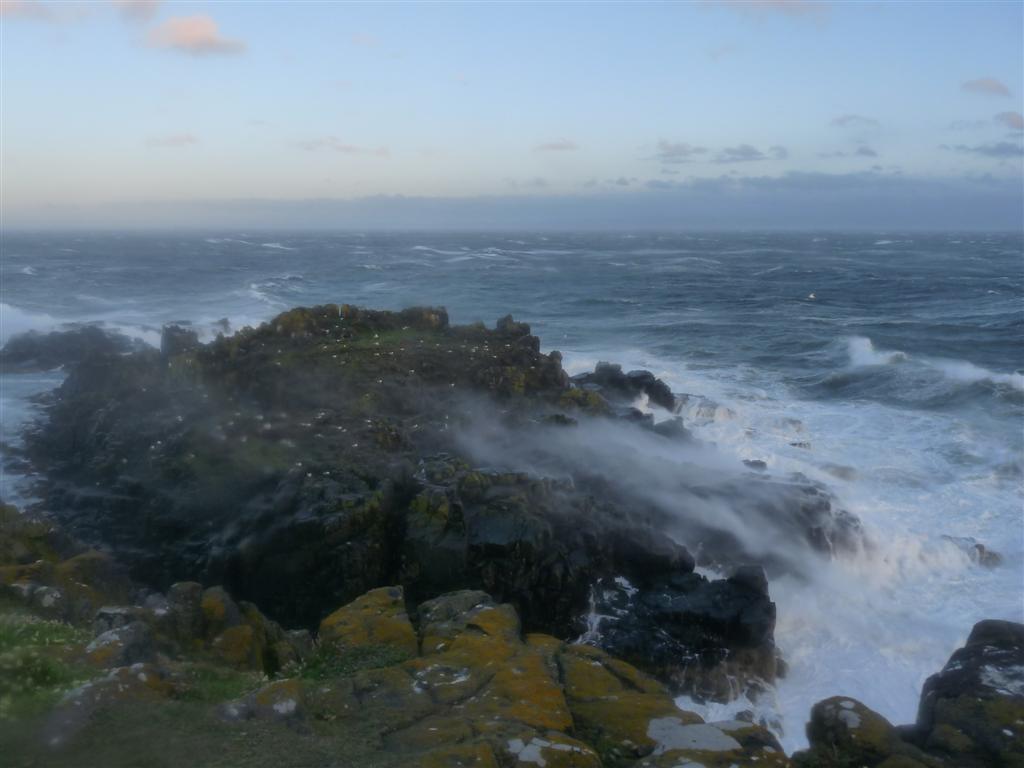
our kitchen window is very important. Especially today. When the lighthouse keepers built our cottages they tucked them down in a cleft to protect them from the weather, but added in one window that gave a view. That window is the first place people look when they get up, as well as all through the day. The view gives us birds, boats coming and going, state of the tides in the harbour, the coming and going of people and of course the weather. So today we spent a lot of time looking out of it. The forecast for today had been diabolical for several days so we knew what was coming. Most have us have got colds (thanks Francis !) and the weather meant no fieldwork so people were gathered in the living room, drinking Sarah B's fantastic hot toddies and every so often someone would get up and stare out of the window. By lunchtime the moans and whistles from the wind around the cottages had started and at the west end of Fluke Street the spray from the west cliffs was starting to hit the windows. By mid afternoon things had got much worse. A walk out to the south end overlooking the Maidens was a battle and I don't mind admitting that at one point I was going along on my knees round the south horn. The seas confronting us were just amazing. The swell that was rolling was huge with the surface of the sea being ripped off and sent over the island. But after tea at eight o' clock when the tide was at its highest it was past describing. Neither my words or the photographs can really portray the sight of the waves pounding in on the rocks, the spray blown right across the island, the roar of the wind but it will be a sight to remember. Trying to capture it on film was very difficult as the spray almost immediately covered the lens fogging it up. It got particularly bad when I had found that I had used the wrong handkerchief to clean the lens and found I had smeared the whole lens with snot from the afor mentioned cold. But in all of this we all felt for the birds. The full extent of what damage has been done will be seen in the morning and the next few days but there will be many nests and eggs washed away, we saw whole kittiwake nests sailing through the air while eider and shag chicks will just not be able to survive the wet and cold. Will keep you posted on what things look like tomorrow.

Saturday, 21 May 2011

Eiders again - the toilet duck is hatching.

The toilet ducks chicks are hatching today.

The toilet duck on nest.

The engine room duck.


Things are happening with the eiders on the island. A few weeks ago it was mayhem on the loch as all the pairing up went on. The females then headed out onto the island to find a site for their nest and these are literally all over the island. Some hide away in undisturbed parts of the island where people seldom go while others nest right in amongst us. There is one duck that nest right out side the toilets of the visitor centre and so has thousands of people cue up virtually next to her, she now has the unfortunate name of the "toilet duck". And then there is the "engine room duck" and the "Internet cafe duck" who nests on the concrete pad outside the cottages where we can get a good mobile phone signal. It might be that these ducks next in these places because the presence of humans keep their main threat, the gulls away. But some females nest right in the middle of the gull colony which seems very odd but gulls will even eat each others eggs in a colony so maybe they are spending so much time guarding their own eggs that they won't worry about predating an eiders.
These eiders have an incredibly strong instinct to brood and it takes a lot out of them. The eggs take 26 days to hatch and during this time the females may only leave the nest to get water. When they do this they cover their eggs with down and vegetation to hide them and head for the nearest pool. So by the end of incubation the females can have lost up to 40 % of their body weight, sometimes being in such poor condition that they lose their waterproofing of their feathers. It has been known for an eider sitting on sterile eggs to have died on the nest rather than leave the eggs. All through the 26 days gulls and people are the greatest problem. Gulls will hassle and gang up on a female that looks flighty and take the eggs if she moves. People are a problem if they step off the path and frighten a female off her nest, then the gulls come straight in and we have lost a couple of clutches this way this season.
And now the clutches are starting to hatch. As soon as the ducklings appear the female has to head off to the nearest water for her and the ducklings to feed, protecting the ducklings from gulls as she goes. In this she gets help from other females either non or failed breeders that are often related. Over the next couple of weeks the mortality is high for the chicks but enough will survive to come back in future years.
The Isle of May is a really important place for eiders. It is one of the largest concentrations of breeding eiders in the UK holding about 5% of the Scottish and 3% of the UK breeding population. The numbers rose rapidly during the 1980 and 90's but seemed to have stabilised at roughly about 1000 pairs. Islands are important because on the mainland they are often disturbed on the nest by walkers and dogs. In one area of the East coast the breeding eiders have almost disappeared after the opening of a coastal long distance path.
And today the toilet ducks chicks started hatching, a special treat for visitor on the boat. But once the chicks have hatched from all of the nests around the cottages I will miss the early morning wake up call that we get from the females talking to each other with their "muck, muck, muck, muck, muck" call. Until next year.

Thursday, 19 May 2011

A Bit of a Blow


Yesterday was quite a day. It started a bit breezy and gradually built up through the day to a force 7 blow by high tide at tea time. At lunchtime James, the skipper of the May Princess decided not to sail even though the wind was forecast to drop and it was the right decision as otherwise Bethany would have had to cook macaroni cheese for 107 instead of 7.
At high tide the west cliffs were receiving the full force of the waves with the spray reach the tops of the cliffs and blowing in a sheet across the island at Alterstanes. And all this will a gleaming blue sky. For us on the island it felt quite a blow though for the island itself it barely rattled its stony bones compared to some of the storms it will have seen over time. We took pleasure and excitement in the gusts and spray but others were having a harder time.
The main colonies of sea birds are along the west cliffs and with the expansion of some of the seabird populations the lower ledges of these cliffs have now been colonised and these were in reach of the waves and spray. Kittiwakes were ruffled and wobbled on their nest platforms, shags with chicks were soaked by spray but the razorbills and especially the guillemots and bore the brunt. At Greenface the lowest shelf holds several hundred guillemots and all but a few of these had to leave the shelf and their eggs will have been washed away. For those of us used to hens this might not seem too important but guillemots only lay 1 egg a year which takes a lot of their hard won energy and to make and lay another takes up to 2 weeks. As the season is so early some will try to lay another but many won't. What is odd is that when I looked at the shelf today it was completely packed with birds again. This is because there is such competition for nest spaces that the bird will stay in their nest site for the rest of the season just to prevent other birds taking them over.
These birds play the long game in that they only lay 1 egg a year but live for a long time so if they miss one year because of bad weather or lack of food they just have another go next year. But the problem for these birds is that climate change is making this weather events more common and so if there eggs getting washed away occurs on more occasions during their lifetimes they will produce few chicks with a knock on effect to the overall population.
So suddenly it occurred to us the direct link between the future success of the seabirds that we see on the Isle of May everyday and taking the car instead of walking, buying food jetted in from around the world instead of locally produced, turning on the heating instead of putting on a jumper or flying off abroad for lots of holidays abroad.
Still a good thing about the storm was that it washed up a perfectly good laundry basket which saves us having to buy one.
Thanks to Mark Newell for the excellent photos.