Sunday, 5 June 2011

Yellow Heads


PhD student Bethany Hawkins spills the beans on what has been capturing visitors interests for the last few weeks on the island:
"Recent visitors to the Isle of May may have noticed an increase in numbers of a rare sub-species of the black-legged kittiwake known as the yellow-headed black-legged kittiwake (Rissa tridactyla aurocephalus). These birds can be distinguished by their yellow heads which vary from a pale shade to a striking golden colouration. The first sighting was on the evening of the 25th May and since then a total of 48 individuals has been recorded...Ok, so before all you twitchers set off on an epic journey to this windswept island off the East Neuk of Scotland just to get another ‘tick’, I’ll admit that our local yellow-headed black-legged kittiwakes are in fact the result of my very own artistic handiwork. I’ve been catching individuals in order to take measurements to help me understand the condition of the kittiwakes breeding here on May. Body condition may link food availability to breeding success, helping us to better understand why this species is declining. Once caught, ringed and measured, I’m marking my kittiwakes with yellow dye so that I can spot which ones I’ve caught without having to re-catch them and read their tiny metal rings. I actually think they rather like having their heads painted...I guess it’s not unlike going to the hairdressers and having your hair washed and head massaged...and I pay good money for that! Quite what the kittiwakes’ other halves think when they return to the nest I can’t be sure, but so far I’ve not seen any hair-style induced domestics. The only trouble with the dye is that the kittiwakes have a tendency to go for a wash in the sea after being handled by a human (I don’t blame them to be honest, judging on the shower restrictions of 1 shower a week out here!) and therefore wash off most of the hair dye along with the human filth. So, individuals with a good sense of personal hygiene aren’t as easy to spot from afar compared to those that are clearly embracing the culture of minimal washing adopted by us researchers. I’m hoping to re-catch the yellow-heads so that I can compare body condition of individuals early in the breeding season with later in the season to see whether they are in poorer condition after the stress of raising their chicks. However, the success of this re-capturing depends on how cooperative the yellow-heads are feeling when I approach them once again, armed with my ruler, scales and a paintbrush!"

Friday, 3 June 2011

Tossing puffins

To most visitors to the island the puffin is king.

Hanging around waiting for a puffin to hit the nets.

A close up of a puffin, this one has some dark feathers on its face which are left over from its winter plumage.

A puffin being ringed.


Searching for dropped fish

A photo session for a carefully held puffin.

A beak ful of small sandeels.

A huge sandeel, a big mouthful for a puffling.

Tossing the puffin.


The puffin is the main draw for most visitors that come to the Isle of May, only once has someone ask me where they could see shags on the island. People come from a long way away just to see the puffins, one lady earlier on in the season said she had come all the way from Canada to see them. But the visitors usually don't know that much about them and their lifestyles. This is partially because they spend a lot of their time ashore underground in burrows where they lay their 1 egg and incubate it which makes it hard to study them. But on the Isle of May the puffins have been studied for nearly 40 years. When the research started there were only about 1500 pairs on the island but this grew to 69000 in 2003 though an increase in adults not surviving the winter means that the population is down to about 45000 pairs now.
One of the ways of finding out more about the puffins is to catch them when they are bringing back fish to their young. This a a weekly occurrence on the island and is down on a fine evening and early the next morning. So after tea we set up mist nets along Holymans Road and then we sit down a wait. It is a nice social time for those of us involved though stories and chats are always interrupted by incoming puffins as sometimes immediately, sometimes after a wait a puffin hits the net and gets tangled and we spring into action. A quick sprint down to the net means that the bird can be extracted before it gets even more tangled but also we have to be quick off the mark to gather its valuable haul of fish before the gulls get in and pinch it.
It has to be said that a puffin in the hand is not the quaint, comical creature that many people think they are. Basically they are very sharp at both ends and grumpy in the middle. A puffin's bill is incredibly strong and it likes to use it. When you get them out of the net they usually manage to grab a sensitive bit of hand like the webbing between thumb and forefinger and then squeeze. Meanwhile at the other end they have incredibly sharp claws used for digging burrows which they scrabble around until hooked them deep into fingers. This make putting a ring on there leg a less than pleasurable experience and often quite bloody but a worthwhile scientific task. The ring with its individual number enables us to know a puffin if we recatch it or if it is found elsewhere. We also take measurements of the wing length and its weight and then the bird is released. There is a technique to releasing them, they need to be tossed into the air so that they can get lots of lift to accelerate but it pays to make sure that the claws have been disengaged from skin first before tossing. The fish that the bird was carrying is really valuable and so is collected and put in the freezer. It is from this that by measuring and weighing the fish we can find out how effective the puffin has been at fishing so what sort of food the chicks have been receiving. It also gives us information about the state of the fishery off the island. So the puffin may loose one load of fish out of hundreds that it might bring in during a season but the gain is further insight into how well these amazingly popular birds are doing.

Thursday, 2 June 2011

Old shags and seabird puke

Mark ringing a fulmar chick.

Catching shags in the early morning.

A shag on nest.

Guillemot and chick

Colour-ringed razorbill.

Colour-ringed Kittewake

Discarded sandeels.
Mark Newell oversees the day to day research programme on the Isle of May for seabirds and has a very detail knowledge of the islands birds:

"Returning to the May Isle for my seventh season in my current guise working for the Centre for Ecology and Hydrology (CEH) I am finding each season vastly different. As mentioned in previous blogs we are experiencing one of the earliest seasons on record which has meant adjusting the timing of our work. Part of my role on the isle includes coordinating the arrival and departure of the various researchers and ensuring there are enough beds to go around without having to top and tail and this is something akin to herding cats. An unexpectedly early season involves various changes of plans and a fair bit of juggling.

When not playing some kind of quartermaster role it is up to me to coordinate the long term studies on the isle which are now in their 40th season. Between us we follow up to 800 pairs of Guillemots from when they lay their eggs right through to the father leading the chick to sea. This requires several visits a day to the hides to check on progress and this is quite exciting at the moment as the chicks are hatching. I find myself looking out for certain pairs where I saw the female laying in the hope of seeing the chick hatch. However, on most occasions we just see some broken egg shell before glimpsing the chick at a few days old. Similar studies are ongoing with Razorbills but they are even more covert with the stage that they are at. We are also on the lookout for colour ringed birds. We have Guillemots, Razorbills, Shags, Kittiwakes and Puffins all with an individually inscribed ring or a unique combination of rings. This allows us to get an estimate of survival of birds from one year to the next. So far this season we have a pair of shags where the male is 22 years old and his mate is 19 years old. We also have a nest where two females are sharing incubation!

We will soon be catching birds for ringing and occasionally they throw up their dinner. To most folk this is pretty disgusting but to us it is quite exciting as it allows us an insight into their diet. Ideally most of the seabirds here wish to feed on large sandeels as they are the most nutritious so if we start finding different fish or very small sandeels it can help explain why in some years the birds do poorly. Only this morning I picked up some sandeels from one of the paths which would have been dropped by a puffin, probably to escape the attentions of a piratical gull. These fish were measured then stored in the freezer until after we leave the isle when some will be analysed to establish the calorific value and add to the picture of the Isle of May seabird’s successes and failures each year."

Wednesday, 1 June 2011

The big all island count

I've been away missing all the wild weather here on the Isle of May. I spent a very pleasant 10 days in Eastern Turkey looking at wildlife and historical sites. Below is a picture of me in a Turkish Shepard's over garments in the Tarsus mountains.


It's now the busiest part of the season for me. I have to count all the crag, ledge and cliff nesting seabirds on the island. I have to have completed this in the next 8 days. I have already counted Rona. I'll be tackling some of the big colonies tomorrow.


Tuesday, 31 May 2011

The Purple Shed

The deluxe version hide!

View from the hide –you can just about make out a front on the water surface.
It isn't all about birds on the Isle of May, Evelyn Philpott tells of her research project below:
"I’m a new addition to the community of researchers on the Isle of May this summer. I’m a PhD student from the University of Aberdeen studying the interactions between seabirds and oceanographic variables in a tidal stream off the south of the Isle of May to inform the potential deployment of a tidal energy turbine.
Due to climate change and the push to reduce CO2 emissions, different methods of extracting energy from renewable sources are under development. The Scottish government has a target of meeting 31% of energy needs from renewable sources this year and up to 80% in 2020. Last year the figure was 27% so they are well on their way. Tidal energy is one of the sources of renewable energy the Scottish government is keen to pursue as there is vast tidal resource in Scottish waters. Tidal energy is a very new industry and there are many unknowns. For example we don’t know how birds and marine mammals are going to be affected by these devices. Potential impacts are collision risk and disturbance but also indirect impacts such as redistribution of prey species. One of the aims of this project is trying to determine if a small scale tidal device placed off the Isle of May would have ‘significant effects ‘ on the conservation objectives of the NATURA site. Also the Isle of May is an ideal site to promote small scale renewable energy production. The aim is to replace diesel usage on the island and make the island self sufficient in terms of energy supply.
So to start with I need to understand how the seabirds are using the site as it is before a turbine is deployed and relate their at sea behaviour to the local bio-physical data. I have a hide overlooking the southern end of the Isle of May and carry out observations in calm weather conditions and record counts and behaviours of seabirds on the water. At the same time I have some equipment moored about 500m from the coast recording water temperature throughout the water column, current speed, current direction, salinity, and chlorophyll levels. I also have a C-POD which logs the echolocation clicks of porpoises and dolphins.
So far this season has gotten off to a bumpy start given the breezy weather conditions. My hide has managed to survive the storm thankfully and I’m hoping the next few days of calm weather will let me get started in earnest."
Evelyn Philpott
24th May 2011

Monday, 30 May 2011

The Shag's Feet

[1]cute or ugly?
[2]shags by night
[3]non-dainty female
[4]getting a bit big for the nest

Hello, I’m Katherine Herborn, a postdoctoral researcher at Glasgow and one of the seabird scientists on the Isle of May. I live here from April to June whilst my study species, the Shag, breeds on the Island.
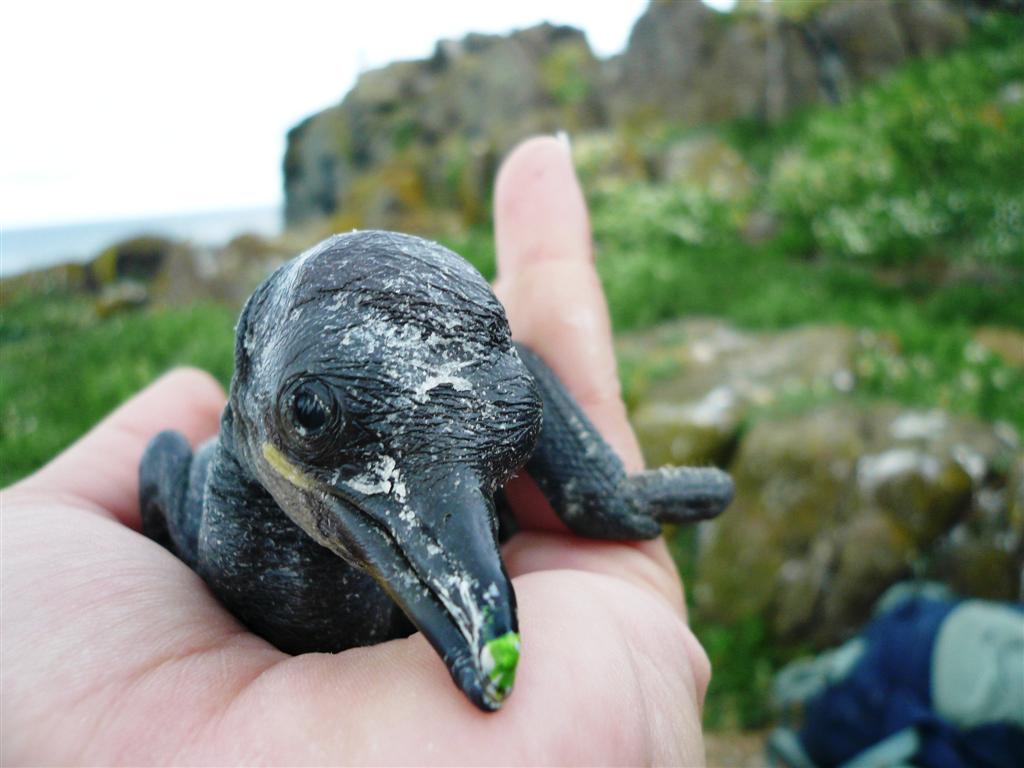
Shags incubate their eggs with their feet. In a little over a month, this foot warming helps a few tiny cells grow into a hideous 35g chick, like this one[1]. We at Glasgow have been wondering whether a shag’s ability to keep it’s feet toasty, and nurture this growth, gets better or worse with age. To find out, I have temperature sensors in the nests of shag parents of various ages, from just 2 years old to an ancient 23.
As both parents share incubation duties, it is important to know which – the mother or father – is on the nest when I am recording egg temperature. To work this out, I have “shagcams” set up around the island to photograph my study nests once each minute, even at night [2]. You can tell the males and females apart by the colours of their leg rings (when they show them) or the shapes of their bills. Females are usually daintier. Occasionally though, less than dainty females are captured on camera..[3]
By now, in late-May, most of my eggs have hatched. So that’s part I of my study: the incubation phase, over. Next, I will see how the warmth of the early nest environment then effects growth in the chick. In the next 30 days, these tiny, wrinkly souls blossom into beautiful 1 kilo whoppers! Who still like to shnuggle up under mum and dad [4].

Sunday, 29 May 2011

Stick to the paths


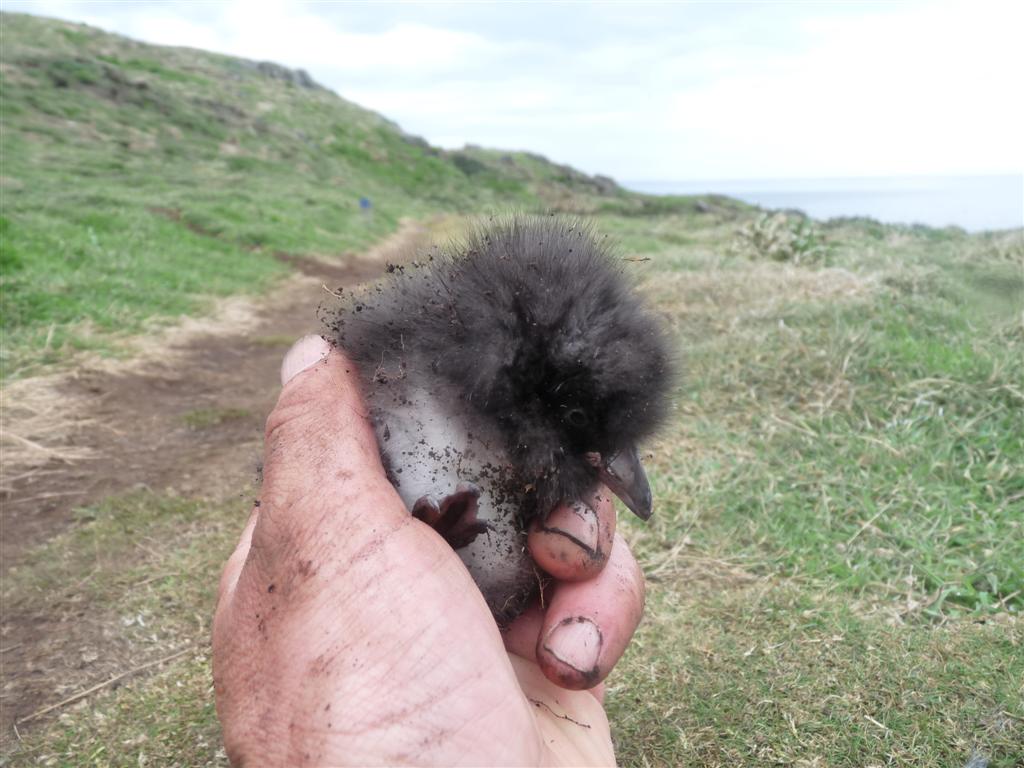
This little monster believe it or not is a puffin chick or a puffling.


Everyone that visits the island is given an introductory talk and this is to keep the visitors safe and the birds safe. The main thing we ask of visitors is to stick to the paths as if they stray they can have quite an impact on the breeding birds of the island that they have come to see. For instance there are about 45000 pairs of puffins that breed on the island in burrows a few inches under the surface of the soil. A person standing on a burrow can easily crush the tunnel and what is inside. Exactly this happened the other day but in this case the newly hatched puffin chick or puffling wasn't hurt. However the parents won't return to feed the puffling if light is getting into the burrow, so for this chap I needed to go and repair his burrow. Firstly I hoisted him out to check that he was OK (he told me he was quite loudly), I then cleaned loose soil out of the burrow and patched the hole in the roof with an old roofing slate before covering over the slate with soil and turf putting the little chap back in.
Some people don't believe me when I tell them that this sort of thing can happen and that they should stick to the paths but maybe by reading this they might now!
An puffin below bringing in a large sprat instead of the more usual sand eels. Some chicks will have been very full after all that !