Wednesday, 18 May 2011

Rabbits


So guess what the most common question is that I am asked by visitors ? Is it "where can I see puffins ?", or "do you get bored ?" or "do you have a TV?" ? Nope, none of those, it is "why are all there all these rabbits here?" and quickly followed by "are they a problem?". It has to be said that the rabbits are a very obvious island inhabitant at the moment but it hasn't always been so. The rabbits have been on the island for a long time, the first mention of them came in 1329, nearly 700 years ago, when apparently the King's Chamberlain paid out 8 shillings to four men to go and catch some. The rabbits had been introduced to the island when the Priory was built and would have been an important source of food and revenue. There would have been specially employed "warreners" to look after and harvest them but by 1549 when the island ownership passed from the Priory of Pittenweem, the island was said to have been "spoiled of rabbits" after apparently the English destroyed the warrens. By 1884 the island was grazed by 6 milk cows, 1 horse, 3 donkeys and up to 60 sheep which suggests that the rabbit population was still pretty low however now the rabbits grazed the whole island so tight there would be very little grazing for 1 sheep. It was only a few winters ago that the rabbit community crashed due to over-population and disease and the consequence was the the island took on a very shaggy appearance with flowers appearing where there never used to be flowers. But the rabbits have done what they do best and with 3 summers there are rabbits where ever you look. Apart from disease and lack of food the other control factor is the Greater Blacked Backed Gulls which munch young rabbits at a terrific rate.


At the moment on an evening walk it is common to hear the squealing of a young rabbit being snatched by a GBB Gull and take for a flight. But there are only 40 pairs of gulls and probably thousands of rabbits.
Another common question is "are the rabbits a problem ?" and the answer to that is no as it is actually the rabbits that give the Isle of May its attractive appearance of a carpet of sea pink and sea campion. If rabbits were removed as grazers then the grasses that they mow down would swamp out these beautiful flowers and within a few years these wild flowers would be greatly reduced.

The short turf that the rabbits produce is also good for the puffins as a short turf is easier to dig a burrow in rather that thick matted vegetation. So the rabbit even though introduced has become a vital part of the island ecosystem and we actually have a lot to thank them for.

Monday, 16 May 2011

Back On - an update

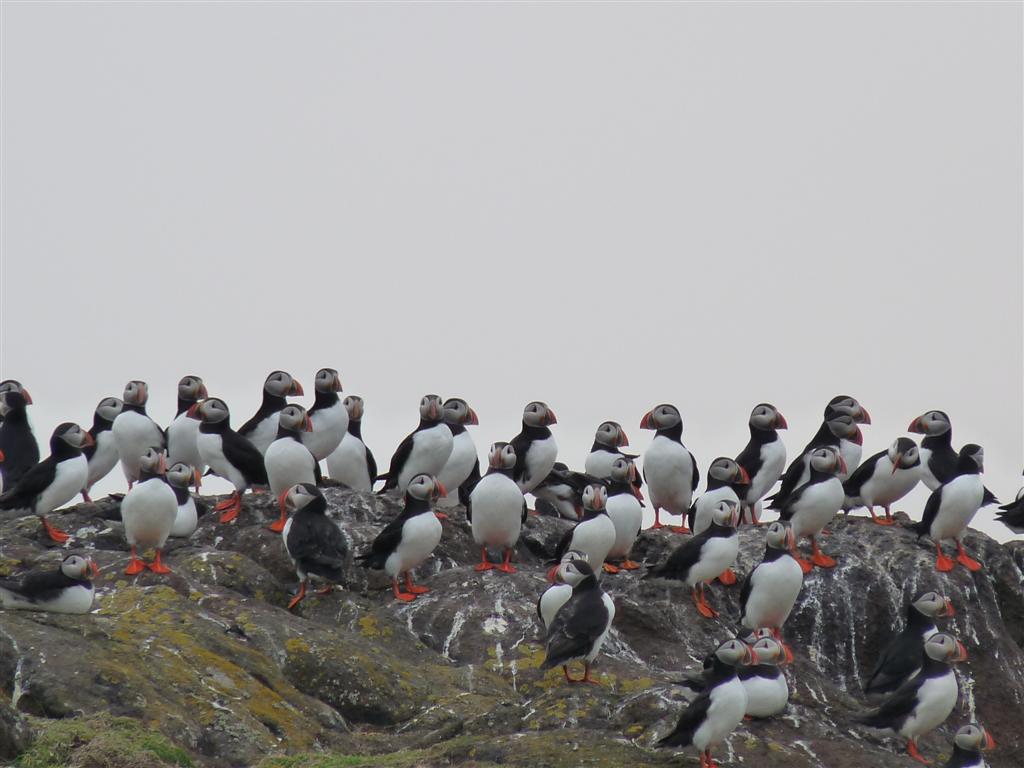
After a few days home I am back onto the island and am here to stay for the next month. This is the really busy time with the seabirds building up to peak season and lots of researchers and visitors coming to see the birds. And today it blew an absolute hoolie. 28 intrepid souls made it across in the May Princess and despite a few suffering from the mal de mer, were rewarded for their bravery with a fantastic puffin day. On these very windy days the puffins hang about on the west cliffs with their faces into the wind. This makes it easier for them to take off, puffins have proportionally small wings which need to be flapped very fast. They can fly pretty well but it is the stopping and starting that they aren't very good at but a bit of wind gives them lift. One puffin that flew over was making a very strange noise and I saw that one of its feet had got tangled in a carrier bag which was streaming behind it. Another case of the ever present plastic and the effect that it can have on wildlife, in this case many miles from where it was first discarded. Oh and just to keep you up to date with the beer shag (mentioned in the posting 3rd April) that had the plastic rings that hold beer cans together wrapped around its neck. It was caught, disentangled and released and is now getting on with the serious business of feeding chicks. Lets hope the puffin also gets free to have a successful season maybe this is a reminder to please dispose of your plastic responsibly.


The terns have come back in stronger numbers in the last week and we really hope that they have a successful breeding year after the last couple of very poor ones. There are reasonable numbers up at the Beacon and in the Priory but they need a few more to have the sort of numbers that make a strong colony that can repel the gulls that try to eat their eggs and chicks. Today the terns seemed to spend more time on the ground perhaps just to stay out of the wind. Up at the Beacon the wind was gusting so much that I saw one tern sitting on the ground blown over and for a fleeting moment its little red feet paddled in the air.

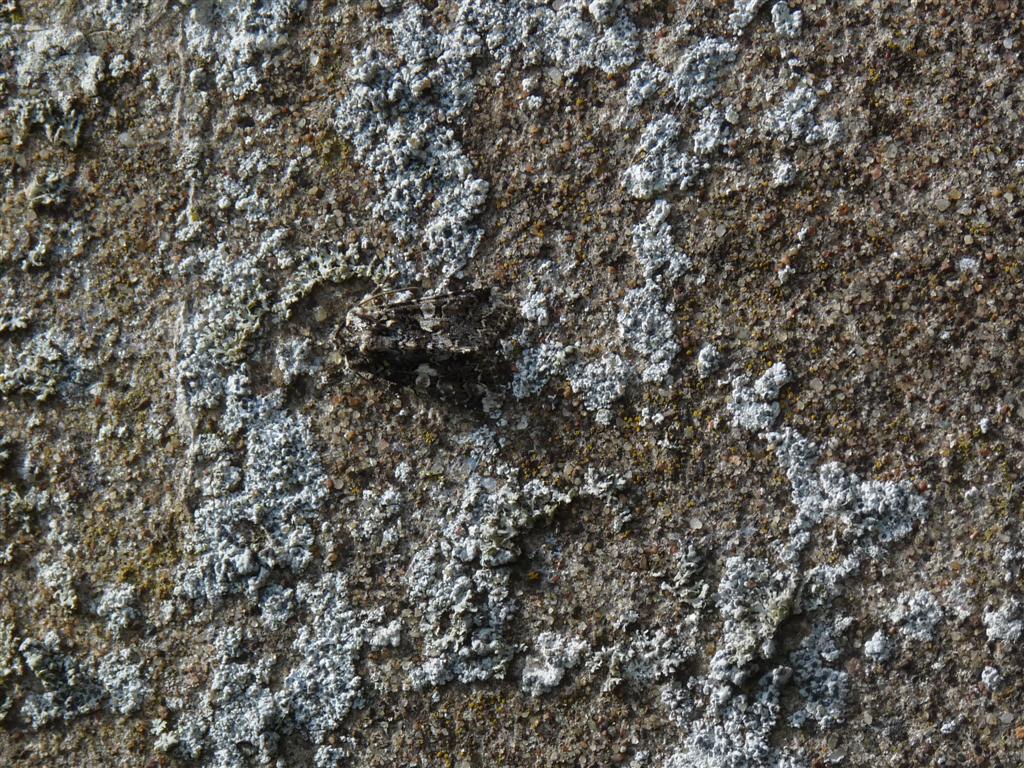
The cold, wet and windy weather hasn't suited some of the island inhabitants. We set a moth trap every night that attracts in and holds the moths so that they can be identified and released unharmed in the morning, but so far there have been very moths around. However two in the trap this morning were worth looking at. The Marbled Coronet is very common on the island as the food plant of its caterpiller, sea campion, is everywhere. It is beautifully decorated and a perfect match for a lichen covered wall.


The Spectacle is not so much of a spectacle when you first look at it and you wonder why it gets its name...

....until you look at it head-on and it all becomes obvious. But why has it evolved to have those eyes ?

Not all of the wildlife on the Isle of May is as obvious as the terns and the puffins so here is a bit of coverage for some of the bit part actors.
Though the wind was cold these 2 rabbits found a nice bit of shelter to sunbath. I thought that they had been run over until they saw me and scampered off.

...while these 2 shared some spoils found by the picnic tables (I wish people would pick up their rubbish).

And these 2 pigeons were playing Romeo and Juliet in the Priory while the terns went potty arond them.

Sunday, 15 May 2011

Seabird research on the Isle of May - kittiwakes


Bethany Hawkins, Kittiwake researcher with the Centre for Ecology and Hydrology (CEH) writes about why she is spending the summer on the island:

"I’m back out on the Isle of May this summer for the second field season of my PhD. For my PhD I’m researching how climate change is affecting the body condition of breeding kittiwakes as a result of reduced availability of their prey, the lesser sandeel. Warmer seas mean less sandeels, which mean hungry kittiwakes and hungry kittiwake chicks. Birds in poor body condition are less likely to breed successfully due to the high energy demands that raising chicks puts on their parents. This means that I can relate climate change to the condition of breeding kittiwakes and to their overall success or failure. So what am I doing day to day at the moment? Well, the kittiwakes, like all the seabirds this year on May are breeding earlier than they have for years. So many have already laid their eggs and some have clutches as large as 3. Each day I’m checking nests at various sites all around the island to see who’s laid and how many eggs they have. I’ll continue this monitoring throughout the season so I can get an idea of when birds fail or how many chicks they manage to hatch and fledge. I’m also catching adults to take measurements like head and bill length, wing length and mass, which give a good indication of body condition. But for now, back to my egg-spotting... "

Sunday, 8 May 2011

Waiting for a boat


I woke this morning to a holiday atmosphere on the island as it was pouring with rain and blowing an easterly hoolie. This meant that the researchers didn't have to go out to do fieldwork so some lay in bed until mid morning. Those of us who had other things to do that weren't weather dependant had to keep plugging away, for me it was the monthly report and event planning. The May Princess was cancelled as the easterly winds were piling the waves into the harbour entrance but there were 5 Spaniards that were trying to get out to the Lowlight to spend 4 days photographing the seabirds. So a RIB was scheduled for 1500 and Rinchen and I went down with the quad bike to meet them and carry their gear up to their lodgings. The RIB was late but that is never a problem as I love waiting for the boat. It is time that you can't be doing anything else so you have to just sit down by the jetty and watch what is going on around you. And there is always something to see. Today the harbour was still filled with eiders but the frenzy of courtship has cooled as there are few females left to mate with. Instead the males seem to sit around on the rocks or preen or surf on the waves coming through the harbour entrance. What the kittiwakes were doing I am not sure but a group had also gathered down on the rocks. Some seemed to be catching small insects off the weed while others just roosted. A stern looking greater black backed gull (shortened to 'Geeb' on the island) stood motionless thinking bad thoughts in contrast to the busy, hyper oystercathcers. When I took a few steps the herring and lesser black backed gulls yelled abuse at me until I stood still again. And all of this you can miss when you are rushing around so I never mind waiting for the boat. When the RIB came in it needed some careful helming to avoid the rocks in all the wash and surf but the Spaniards look pleased to be here or at least to be off the boat. Their induction to the Lowlight and the island proved to be a bit of a challenge as their English is sparse and my Spanish is rubbish so we never got to go into the finer details of the chemical toilet but they will work it out. Sooner rather than later perhaps as I gave them a bundle of May rhubarb as a welcome but they had never seen it before and seemed to think that it went raw into salad! Hope they followed my cooking instructions.
I was also cooking tonight, only 8 people in the cottages so not as bad as when Fluke Street in full and 16 sit down at the table all ferousiouly hungry after day outside. Even when cooking you have half an eye on the window, binoculars close to hand to check the weather, state of the harbour and for any birds moving through.
This evening has turned out fantastic, the wind had dropped but a huge 9 ft swell kept rolling in on the east side of the island and a beautiful sunset was a backdrop to the lighthouses.

Saturday, 7 May 2011

Little Things


It was a good day today. It rained for a fair bit of it, especially hard for the 2 hours when the visitors were on, it blew a lazy East wind (lazy because it goes through you not round you) and I had lots of grubby jobs to do like cleaning the filters on the rainwater tanks of all the accumulated bird poo and detritus but it was still a good day. On the Isle of May there are often lots of little things stitched together that go to make a fine day, poor weather or not. So here is a list of mine today:
- the female eiders serenely sitting on clutches of eggs across the island in the rain, over 1000 of them with pearls of rain rolling off them, a brown bird that is arguably one of the most beautiful on the island,

- the first swift of the year buffeting its way through the showers determinedly moving north,
- a male peregrine hanging in the wind directly above me effortless slipping between the gusts spying out its next prey,

- the May Princess making it in despite a big swell, well done skipper James,
- the 62 passengers determined to enjoy the island even though the heavens opened as they landed and stopped as they went out of the harbour, thanks to Chris from Langbank for leading the way and wearing a carrier bag against the weather for the whole of the visit,

- Rinchen, a volunteer here making an excellent touch table to go in the visitor centre out of scrap wood found around the outbuildings,
- Sarah B (seabird parasite researcher) making the most fabulous tea with biscuit/cake things for pudding,
- it being a stunning puffin day, first thing in the morning it was like a roof of wings with thousands and thousands of them whirling around our heads,


Good huh !

Friday, 6 May 2011

Taking Your Tern with the Water


We woke up to rain this morning. Seeing as we haven't had any for weeks this was a bit of a novelty. And it has a special relevance to us out here because our water supply comes from a well on the island that is shallow and is totally reliant on the amount of rain fall. This is often a dry time of year and coincides with a lot of people staying on the island so a shower ration is in place. People are restricted to only a shower or two a week unless they are voted to have one sooner. A good dumping of rain means that showers for the next week or so are guaranteed. Bethany (kittiwake researcher) was straight in there this afternoon to get her quota of water. Unfortunately a clean and sweet smelling Bethany only showed the rest of us up in contrast.


The rain also suited another of the island inhabitants, the snails. In the dry weather they hide in the cracks of the walls where the oystercatchers seek them out and crack them open. In the rain the snails suddenly come to life, shooting all over the place, racing each other in a burst of exuberance round the rhubarb leaves and up the walls and making every one of my steps a crunch. It is great to see them having fun as long they stay away from my peas and spinach that is just starting to come through in the garden.


Another fine welcome this morning was the sound of screams and clicks coming from above the island. The terns are starting to appear. A few birds have been seen over the last few days but this morning there were over 20 birds whirling around the top of the island up by the Beacon. This is still no where near enough for a proper colony but it is early yet and there is still time for the numbers to build up. The peace and quiet of the island is actually made up from a wall of bird noises from the 200,000 birds living on the island but that cacophony isn't complete until the terns are back. Last month the BTCV volunteers built some nesting platforms for the terns so if you are reading this guys then so far so good, we have a few terns but need a few more before they start coming down to the ground to inspect your nesting squares. I will keep you posted.

Thursday, 5 May 2011

Rabbit in the heligolands.....

The Heligoland traps are one of the first things you see if you come onto the Isle of May. These funnel type traps are used to catch migrant birds that use the island as a stopover before heading off to their breeding grounds. When there are no bird ringers are on the island we cover the traps ourselves. On this occasion we did not only catch birds.....


The rabbit was released unharmed and unringed.....