Showing posts with label shag beer Isle of May NNR. Show all posts

Saturday, 14 July 2012

A few more random shots from this week.


Ian Fisher borrowed the moth trap and caught this Lime-spec Pug. What a stunner! He also took the photo.


Arctic Terns continue to hatch young and even still laying eggs. New nests were found on Wednesday.


This Razorbill jumped just hours after Carrie captured it with my camera!


 Many Kittiewakes are fledging this week.


Last weeks rescued Shag looks no worse for wear after the ordeal it has been through.


We were double figures at the weekend. Like the birds on the cliffs, we are all jumping too. We were down to 6 on Thursday.


Sunday, 8 July 2012

Wood Sandpiper

A little late night bonus blog here.... 

When a Wood Sandpiper flew into the pools on the South Plateau at Dusk, an island twitch was on. 

I managed to locate the Lowlighters and then run up Palpitation Bray to locate Mark who I'd seen at at Sheep Well from about 20 minutes before from the other side of the Loch. It was an Isle of May 'tick' for him.

We all managed to see the bird well. Hopefully the bird will be still here in the morning so we don't have to look at it in the half light.


Wood Sandpipers are a scarce passage migrant in the UK. They are a reasonably common breeding wader in Boreal forests in Scandinavia. This is only the 24th for the Isle of May though the last record was only in 2010.It is also the earliest autumn record for the island. The bird that was seen today was a moulting adult.

Friday, 8 June 2012

The All Island Count

Anyone who visits the island who stands before David and I will hear us say that our job is to meet the boats and count all the seabirds you can see. David and I had a team of volunteers to help us count all the seagulls on the island but when it comes to the All Island Count, 'I'm on my own*'!

I have to count all the cliff dwelling birds. It is quite a daunting task counting thousands of seabirds, Many of which are parts of large colonies. In some ares I can easily see 5000 birds on one cliff face.

I'm often asked how I count so many birds. Well, it's simple! I literally count every individual bird from a safe vantage point. I use a clicker and cover every shelf, ledge, crag and gully of every cliff face.I scan the cliffs with my binoculars. I also take lots of notes and drawings so I don't count the same bird more then once. The island is split up into 16 sections and the totals are added up when the count is complete. It's of the only chance I get to go to secret places around the reserve, creeping along gullies or leaping around the rocks at low tide.


 Kittiwakes, Razorbills and Guillemot are the three most numerous species


I get to creep around little secret Gullies around the island. A Razorbill nearly took my head off flying down this one!


The south horn colony is counted from The Maidens


Counting the high cliffs is quite exciting especially in the fog


A lot of Razorbills were just hatching as I was counting.


Playing on cliffs is dangerous kids. Rope up safe!


That's me looking down 40 metres to the sea!


 How many?


David has a clifftop snooze while waiting to come back from the Maidens

Now come thes report writing and adding up. I'll be reporting back on that soon.

*David kindly helped me with my rope work and The Centre of Ecology and Hydrology helped counting the more sensitive areas where there are the highest density of shags.

Friday, 25 May 2012

A dip in the harbour.

Well it is all change here. Today was the warmest day for a long time out on the island illustrated by the fact that most island residents were in shorts for at least part of the day. Only a few days ago we still had fires lit, were wearing thermals and hats and had to resort to a medicinal whisky each night to prevent hypothermia. Suddenly warm weather has arrived and so have the visitors.
                                       
 Being on the east coast this means a bit of fog in the mornings when the top of the mainlight kept appearing and dissappearing but once it had burnt off then things turned hot.


 The effect has been immediate as last night we had 11 moths in the moth trap compared to the 3 moths for the previous 6 weeks.


 The cliff nesting birds incubating eggs on the cliffs had to put up with the baking until their partner gave them a break. It was great to see they relieved of their duties and drop down onto the sea from their ledge and wash clean their plummage and cool down.This guillemot was panting with the heat while the razorbill below it was suffering from having a nesting ledge lower down the cliffs (raining guano).


It has also changed the researchers behaviour, phone calls can be made outside, we have even eaten tea out-side twice and ...
....tonight a (very quick) swim in the harbour.


 Anything the Farnes can do we can do as well.
It is peak seabird season with so much to see and with this weather set to hold a bit longer, its a great time to visit the island.

Wednesday, 2 May 2012

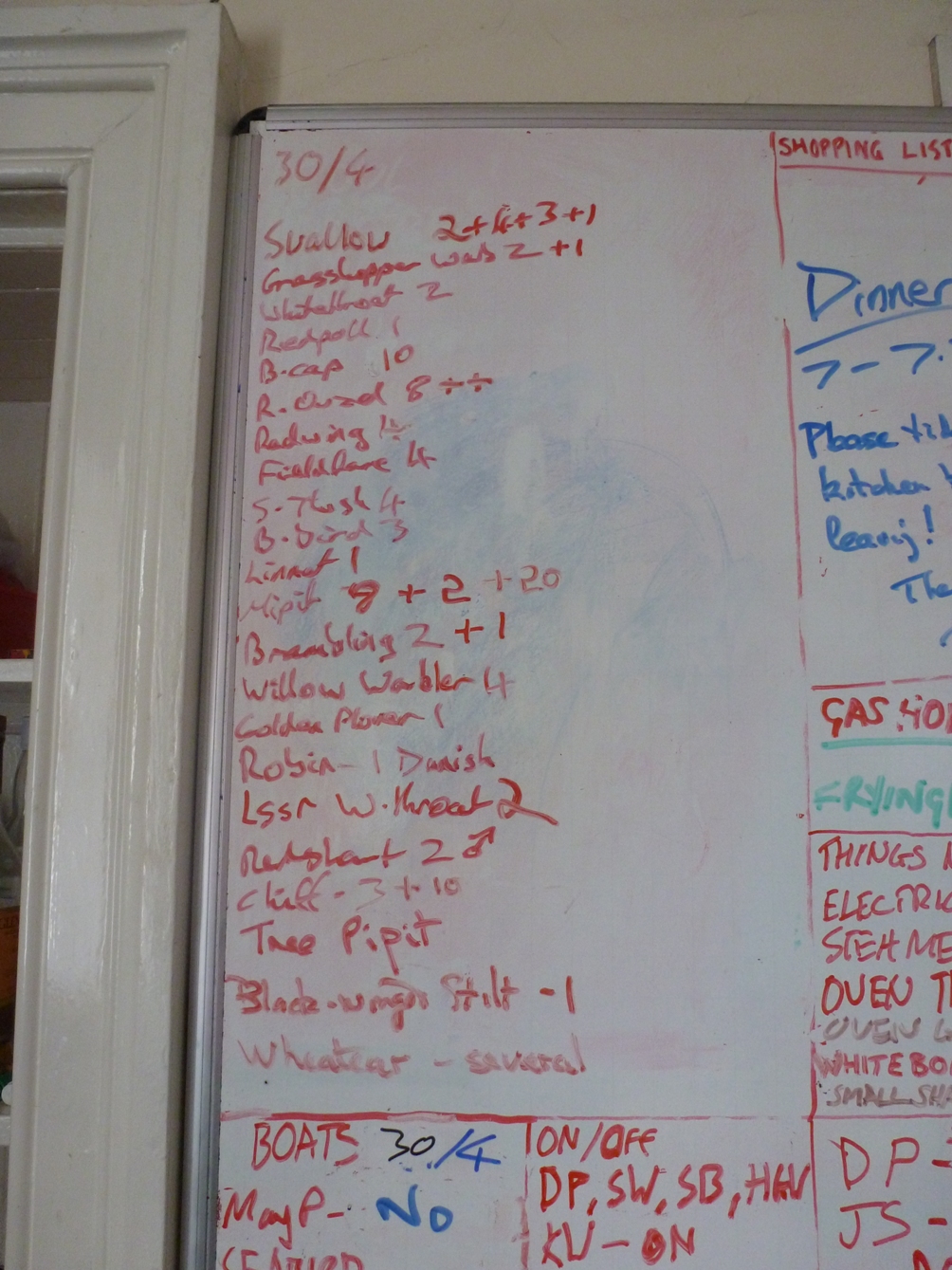
Black-winged Stilt - First record for the Isle of May


On the 30th April I'd just settled down for a late lunch when Mike Harris dashed in shouting he'd seen a Black-winged Stilt at Horse Hole. I dropped my Sandwich and ran to the other end of the island. Unfortunately the bird had gone. I proceeded to search all other water bodies on the island with Mark.

The last place to search was the South Plateau where there are two small pools. As we climbed the slope Mark spotted the bird at the back of the pool. We were delighted. It was a very unlikely vagrant first for the island.

The bird is an elegant wader. Black above and white below with a black cap and a needle thin mid length. It's most defining feature is the long pink legs.

Black-winged Stilts are resident in the Mediterranean with a few breeders in creeping up to northern France. They are a rare visitor to the south coast of Britain with only eight previous records for Scotland. The last time this species was seen  was in the Outer Hebrides in July 1990.

We released the news. The bird was twitched by just a couple of mainland birders but hopefully more visitors will be able to enjoy it if it stays.


 Mikes field notes!

There was also a Nightingale present on the island. This is another very rare bird for Scotland. David and I managed to photograph it to help identify from it's very close relative, Thrush Nightingale.


Nightingale


The board on Monday.