Showing posts with label springwatch. Show all posts

Friday, 6 July 2012

Fulmars

Fulmars

During my last few days of shore leave I was down at Slimbridge Wildfowl and Wetlands Trust doing a bit of birdwatching. As I was walking around the captive bird enclosures a bird under a bench caught my eye.


It was a Fulmar, a very scarce bird in Gloucestershire. This bird was unlucky enough to have been caught in gales that had blown up the Bristol Channel and got lost.


I managed to catch the bird safely but I then realised I'd never handled one before. The birds are naturally very light. They also had a very interesting fishy smell. It also had a very strong bite. It was not too keen on being handled and drew more blood then a any Puffin ever has!

We kept the bird for 24 hours and released it below the Severn Bridge where it flew away strongly.

So what's a story about about my holidays doing on the blog I hear the readers and particularly David asking?


Well, I found our first Fulmar chick today. Fulmars are our last birds to nest and hatch young on the Isle of May. This bird is at Burnetts leap. The bird had just finished hatching. It still had bits of eggshell on it's back. Here is a close-up of the bird


At the time of writing, as well as all the visitor management work i am also writing our annual report and have totalled up the Fulmar count on the island. The total is 286 occupied nest sites around the island which is down by 20 occupied site last year.

Sunday, 10 June 2012

Au revoir Flora....


 Flora waving to the assembled crowd


 The boat heads to Anstruther


 David made sure Flora left


Here's a few shots of the lovely volunteer Flora Hoban leaving on Friday. It was a dramatic exit from the island with Kirkhaven harbour mouth unusable due to the swell. She and David got off safely with the boat fantastically skippered by Colin!

Flora has been coming out to the island for 7 years and is a valued member of the team. She has worked hard painting and doing Tern watches. A good crowd was present to wave her off.

Thanks again Flora for all your hard work. Next year?

Sunday, 29 April 2012

Long-eared Owl

Long-eared Owl


I'd had my Sunday breakfast and decided to go for a stroll. I stopped in and watched the Eiders for a while as the males were displaying to the female. I began to walk up Palpitation Brae up to the Mainlight pausing briefly for a look at a Chiffchaff and a male Ring Ouzel. As I got to the top I could hear a commotion in the Arnott trap. The Pied Wagtails and Robins were all alarm calling. I peeked over the wall to see a Long-eared Owl looking back at me. I dropped back down behind the wall and got the camera out. I rattled off a few shots but the attention of the Pied Wagtail was too much and the nervous bird flew into the cover in the trap. 

I walked back down to the Lighthouse Keepers cottages to find Mark to see if he wanted to trap it. He had actually seen the bird flying onto the island with an entourage of gulls. Though he had not even had his breakfast we set off to see if we could trap it only briefly pausing to stop and look at a Tree Pipit along the way.


Mark expertly and safely trapped the bird and took it to the ringing hut. The bird was ringed, weighed and measured.


Fluke Street and Lowlight occupants all were present with cameras.


The owl was released along Holymans Road away from the gulls. From here it would see the Lowlight bushes where it would be able to roost safely. 

Long-eared Owl is principally an Autumn migrant on the Isle of May. This season seen three already and trapped two of them. Both birds have been adult females. These may well be migrating north to breed in a woodland somewhere in Scotland. They are nocturnal and hard to find so it's always a pleasure to get a view of this breath taking species. 


Saturday, 28 April 2012

A week of birds!


The wind has mostly been coming from the north east this week . This is not great for a couple of reasons. The boats have been unable to land so we've seen few visitors this week and birds which are heading to the continent are having their migration hindered. However there have been lots of birds around the island for us to see and for Mark to trap.


This will not be the last picture of a Long-eared Owl you will see this season if we see more on the island


The lovely black black chin of a male Redstart. There have been three of these cracking birds present on the this weekend. They normally breed in birch trees on the mainland of which there are none on the Isle of May.


The injury to Marks hand was not done by the Redstart!


Here is the Redstart hopping around looking for food in the bare vegetation near the tractor shed.


This is a 'Continental' Robin. It is bigger, greyer with a more orange breast then the birds that breed in back gardens in the UK.

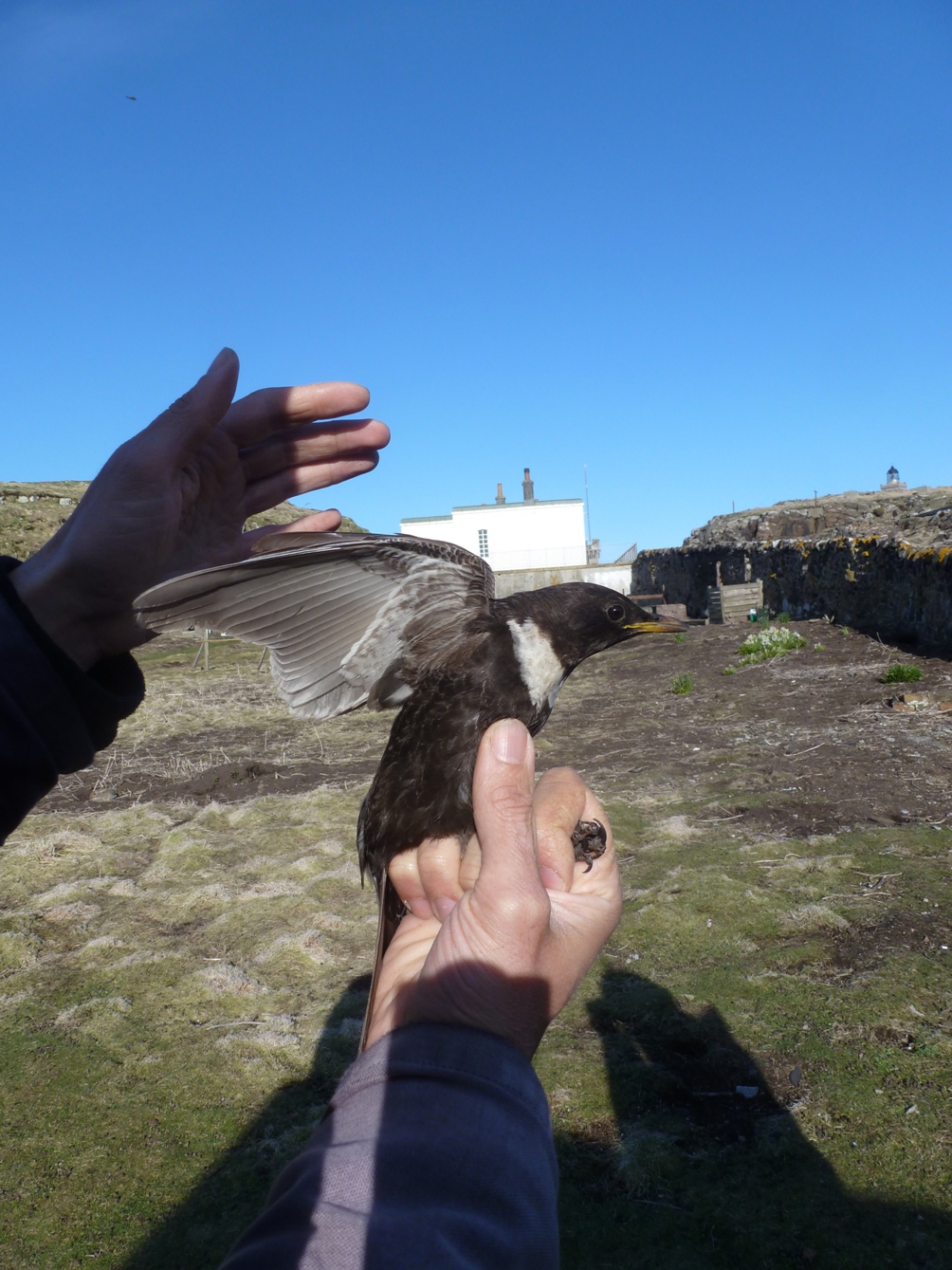
This Ring Ouzel breeds in the mountains. Is it trying to make it's way to Scandinavia?


A close look at this  different Ring Ouzel shows it is carrying a tick.


This is the first Fieldfare I've seen in the hand. What a fantastic bird to see up close!


Here is a Mark doing an impression of James Herriot calving. He's really extracting birds from the catching box.


We've been catching more then just birds in the trap. The girls were more delighted then the rabbits.

Friday, 27 April 2012

Volunteer Paula


A week flies by…

I’m not exactly a stranger to the Isle of May as I’ve spent several winter seasons out here studying the seals. However, it’s hard to imagine the island as a bird haven when my experience of the dawn chorus is one of howls (from the seals) and ‘who’s for coffee’ (from the seal researchers). So when the chance came to volunteer out here for the summer, I grabbed it with both hands.

I’ll be helping with a variety of tasks over the summer – general maintenance, talking to visitors and a bit of seabird research too. I’ve only been here a week, but it’s all been a learning experience so far – cleaning out cupboards has unearthed old equipment and tools from the lighthouse, as well as newspapers dating back to 1934 when a night at the theatre would cost you a shilling (or 5p in new money!). Adding stuff to the touch table has meant cornering a seabird researcher to find out what birds the skulls and feathers are from, and even sitting in the hide counting seabirds has taught me that puffins mate on water. And it doesn’t stop there - although I knew that the rabbits were originally introduced by the monks, I never realised how important they have become for conserving the maritime grassland. As for all the different birds…. well, there’s an awful lot of learning to be done there, but it’s impossible not to learn things when you are surrounded by them 24/7. Hopefully I can pass on some knowledge in return – there might not be as many seals here as there are during the breeding season, but there are normally a few hanging around, so if you’re visiting the island and want to know about them, make sure you find me when you’re here.

Paula (summer volunteer)