Showing posts with label eiders. Show all posts

Saturday, 7 July 2012

Unusual Guillemot


 This unusual Guillemot has been present on the Isle of May for the last three seasons. I've looked for it a few times but had not seen it until the researchers said it was present yesterday. Calum and I went up to the cliffs and despite the poor conditions I managed to capture a few images of the bird.


 The bird has an orange bill and orange feet. It lacks the black pigment in it's bare parts. These birds are not unheard of in the wild and aberrant birds of many species are known. It is a very nice bird to see indeed.


The Guillemot shares a ledge with a Razorbill


A close up of the head

 It has orange feet with black ends to the webs.

The bird has been affectionately named 'Penguillemot' by the researchers because of it's unusual appearance.

Tuesday, 22 May 2012

Ring of Steel


There are many hazards for Eider ducklings. They are born very small and vulnerable. Up to a thousand Eiders nesting around the Isle of May NNR. Gulls are the biggest danger to the ducklings and eggs of Eiders.  I captured this sequence of shots demonstrating a few of the techniques that eiders have adopted to help defend their young.


This Greater Black-backed Gull takes an interest in this creche of Eiders. See how a group of females are working together to protect the young, forming a 'ring of steel.'


An adult breaks away from the group and starts to throw her head back  and calling, threatening the gull.


She then plonks herself down forming a barrier between the rest of the group and the gull


The gull attempts another attack from the front but is driven away by the adult at the front

This group got safely down to the ditch at Horse Hole where they could see shelter. The gull gave up shortly afterwards It is a great demonstration of teamwork by these birds. I hope they made safe passage over to the Fife coast!

Friday, 18 May 2012

How did the puffin get its name?

The other day I got to wondering… how did the puffin get its name? So one wet day I spent half an hour or so scouring the internet, trying to find the origins for the names of some of the seabirds that breed here.
 
Although puffins look more like clowns with their brightly coloured bills and orange feet, their latin name, Fratercula arctica, means "little friar of the north". Perhaps this is because the puffin’s black and white plumage looks a little like a friar’s robes? Or maybe it’s because of the way they run from their burrow, like a monk scurrying to cloisters?


The latin name of the Eider, Somateria mollissima, is very appropriate. Combining ‘soma’ (body), ‘erion’ (wool) and ‘mollissima’ (very soft), their latin name gives us “very soft body wool” - a perfect description of the down that they use to line their nests, and which we use to fill duvets and pillows.


The genus name for the fulmar, Fulmarus, comes from the Old Norse words ‘full’ (foul), and ‘mar’ (gull). “Foul-gull” might seem a bit harsh, but if you’ve ever been on the receiving end of fulmar regurgitate, you’ll understand where the name comes from! Fulmars produce a bright orange stomach oil that is a rich food source for their chicks; it also doubles as a defense mechanism. They vomit this foul smelling oil at predators to warn them off. So don’t get too close…. You have been warned!


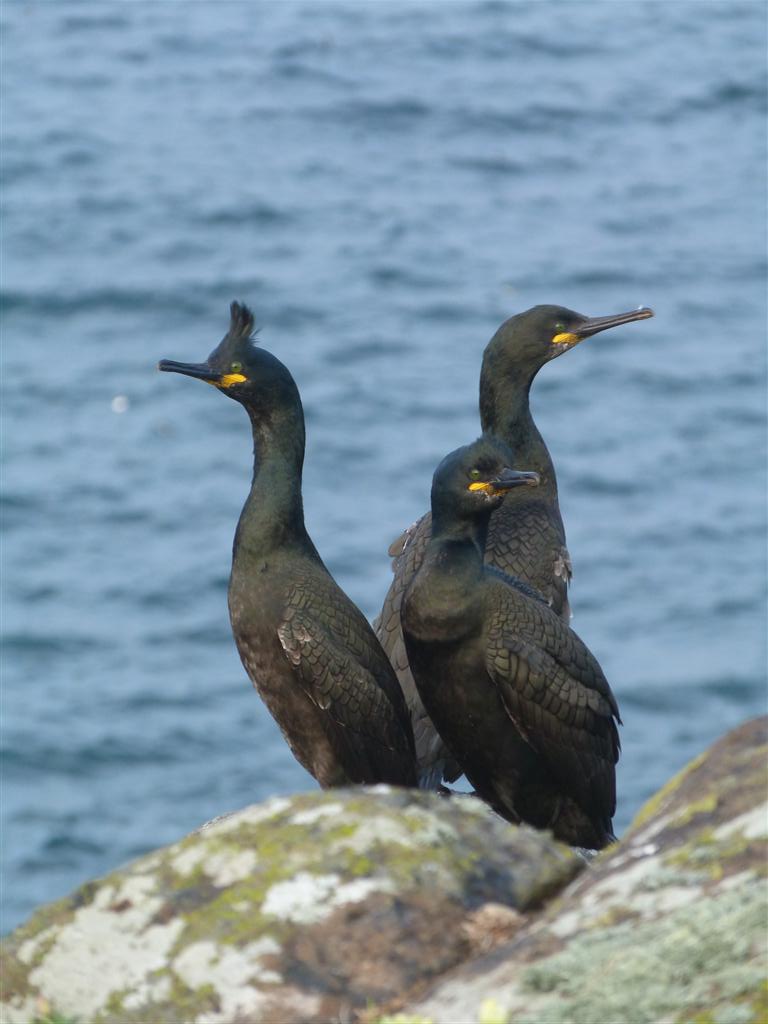
Phalacrocorax aristotelis, otherwise known as the European Shag, has a bit of a misleading name. The scientific name is latinized Ancient Greek, and is a combination of phalakros (bald) and korax (raven) – the bald part of the name may refer to the cheek patches of the adults, whilst the raven part demonstrates the erroneous belief that the birds were corvids.  The common name, shag, simply refers to the bird's tuffed crest.

Paula, Summer Volunteer.

Friday, 11 May 2012

The first of many - eider ducklings

The first 3 ducklings hatched.

The engine room ducks eggs were eaten by a gull.


The eider season is in full swing on the island. Most of the females seemed to have paired up and are busy incubating now. Down on the night club dance floor (the loch) the males are busy pursueing fewer and fewer females and are displaying more and more frantically, just as if the last song is being played.  But one female has caught us on the hop by appearing on the loch with her 3 ducklings about a week before we were expecting to see hatched broods.  She will take those ducklings off across 6 mikles of water to the Fife Coast where there is better feeding as soon as she can.
And once clutch hasn't made it. The engine room duck (named as she sits right outside the engine room) left her nest and the unatttended eggs were taken by a gull. We don't know if she was frighted off by visitors getting too close or left for another reason but it is a good example of why it is so important to stick to the paths and give these beautiful birds a bit of space when they are on the nest.
At the end of the month we will be counting all the eiders on the island and so have a better idea of how they are doing.