Showing posts with label shags. Show all posts

Sunday, 27 May 2012

Listening in - the sounds of the May

The Isle of May is a remarkably quiet peaceful place and visitors and inhabitants are recognise this frequently. So with the thick fog early this morning making it difficult to see you hand in front of your face the sounds of the island came to the fore, disconnected from their source. So I headed out from Fluke Street in a thick grey blanket with ears flapping. Of course with 200,000 birds on a small island it is never quiet, and at Fluke Street we are surrounded by eiders and gulls. The gentle seductive woohoo of the male eider has now been replaced by the more earthy and practical mwuk, mwuk, mwuk of the females talking to each other across the gully or softly to a raft of ducklings on the loch. The gull colony is never silent at this time of year, even in the dark and their loud and varied calls echo from plateau to braes. Heading up Palpitation Brae I enter nervous breakdown territory where 2 of the islands's community go through their daily manic discourse. Oystercatchers are just in a complete state, almost continuously piping at the slightest presence around them. Arctic terns are also in a constant state of over excitement and could start and argument if on their own in a cardboard box. They have such a array of sounds that even when you can't see them you have a good idea of what they are doing. A machine gun burst is aimed at gulls they have taken a dislike to (usually with good reason). Heading out on a fishing mission needs a different set of calls to when they come back into the colony saying "hi look at the size of fish I've caught."
The noise of the cliff nesters only reaches you when you get to the cliff edge but once there the kittiwakes and guillemots have a lot to say and loudly. It is thought that guillemots can recognise their partners call even amongst 8000 seemingly identical individuals all yelling their heads off. I keep a ear open for 2 of the smallest island residents the rockets (rock pipits) and waggies (pied wagtails) as they are the islands intruder alarms. A breakout of twittering from them usually means a bird of prey entering island airspace.
But with all these noisy neighbours it is amazing that you do actually still do much of your bird watching with your ears. once tuned into the island you can pick out something different passing through like the burble of a skylark, the chay of a siskin or the rasping keehaw of a black-headed gull. All of these stand out like a a pink shag on a cliff once you have been on the island for a while.
And then there is the wind of course. 
So for an island that wears a cacophony all the time how come it is so peaceful and calm ? How does that work ?


Friday, 18 May 2012

How did the puffin get its name?

The other day I got to wondering… how did the puffin get its name? So one wet day I spent half an hour or so scouring the internet, trying to find the origins for the names of some of the seabirds that breed here.
 
Although puffins look more like clowns with their brightly coloured bills and orange feet, their latin name, Fratercula arctica, means "little friar of the north". Perhaps this is because the puffin’s black and white plumage looks a little like a friar’s robes? Or maybe it’s because of the way they run from their burrow, like a monk scurrying to cloisters?


The latin name of the Eider, Somateria mollissima, is very appropriate. Combining ‘soma’ (body), ‘erion’ (wool) and ‘mollissima’ (very soft), their latin name gives us “very soft body wool” - a perfect description of the down that they use to line their nests, and which we use to fill duvets and pillows.


The genus name for the fulmar, Fulmarus, comes from the Old Norse words ‘full’ (foul), and ‘mar’ (gull). “Foul-gull” might seem a bit harsh, but if you’ve ever been on the receiving end of fulmar regurgitate, you’ll understand where the name comes from! Fulmars produce a bright orange stomach oil that is a rich food source for their chicks; it also doubles as a defense mechanism. They vomit this foul smelling oil at predators to warn them off. So don’t get too close…. You have been warned!


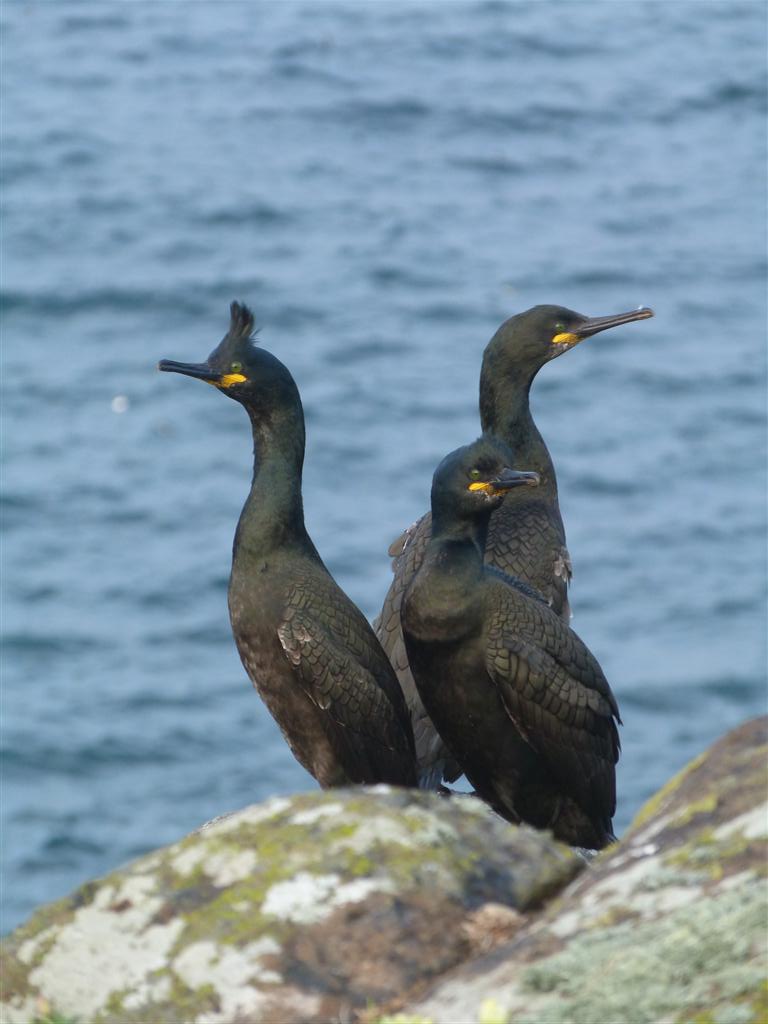
Phalacrocorax aristotelis, otherwise known as the European Shag, has a bit of a misleading name. The scientific name is latinized Ancient Greek, and is a combination of phalakros (bald) and korax (raven) – the bald part of the name may refer to the cheek patches of the adults, whilst the raven part demonstrates the erroneous belief that the birds were corvids.  The common name, shag, simply refers to the bird's tuffed crest.

Paula, Summer Volunteer.

Wednesday, 16 May 2012

Home is where the ….paintbrush is?

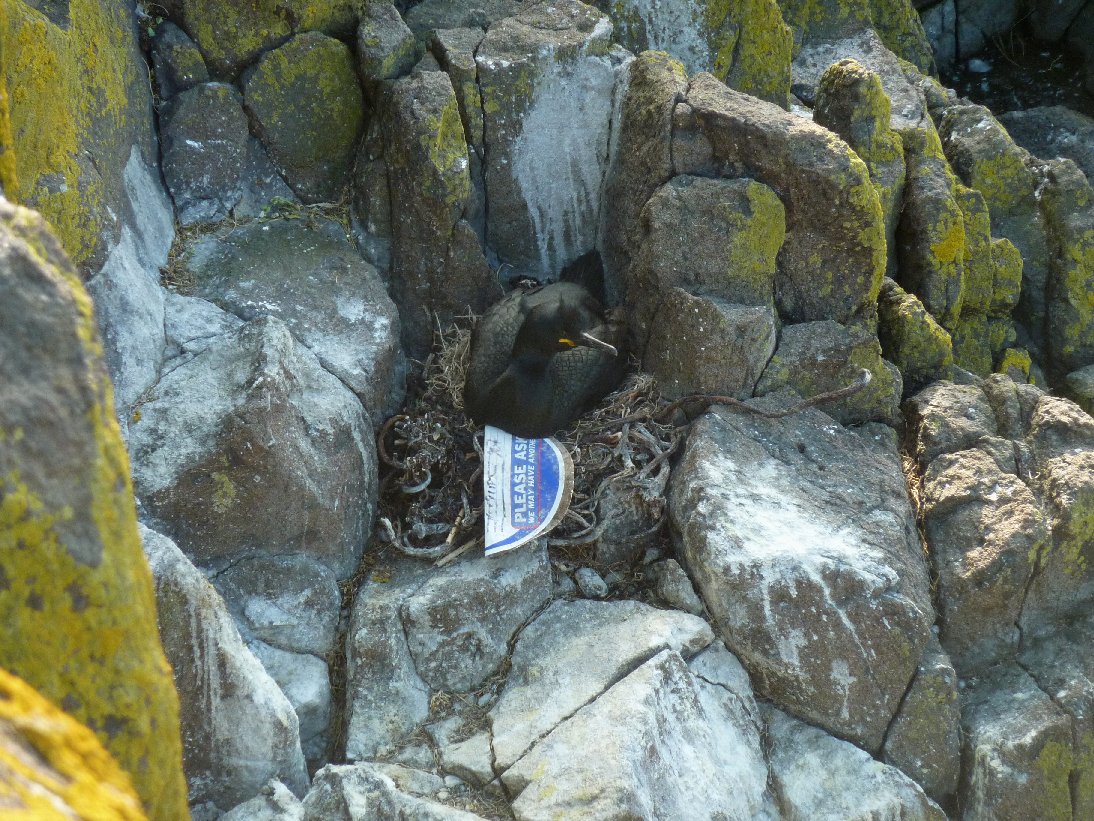
Everyone loves puffins, but what about the other birds on the island? Each species has a unique set of characteristics that give it a charm of its own. The tough little razorbills look like bouncers at a nightclub, whilst the kittiwakes are busy little socialites often seen in groups, collecting mud and grass for their nests, or bathing together in the loch. The shag, however is the king (or queen) of interior decorating! Not one to be content with a bare ledge or a standard nest like other seabirds, shags have an eye for the unusual. Although their main nesting materials are sticks and seaweed, they often amuse us with their little flourishes. Anything ‘stick-like’ seems to attract their attention, with garden canes, cutlery and paintbrushes (unfortunately for the contractors who were painting the Low Light) being prominently displayed. Others appear to have an eye for colour, using different pieces of old rope to produce a bold rainbow effect to their (not-so) humble abode. Among the more unusual items are: a doll, some garden hose, a toy lobster and a padlock! Carrie and Katherine, two of the seabird researchers, have provided the pictures for today’s blog – see if you can spot the unusual things these birds have been attracted to.


Although this is a light-hearted look at bird behaviour, there is a serious note to this blog. Human behaviour has a huge impact on the world around us and the animals that live in it. The items incorporated in these shag nests are a sobering reminder of the rubbish that finds its way into our seas and onto our beaches. It is estimated that one million seabirds and 100,000 sea mammals die each year from swallowing, or getting entangled in, plastic. Do your bit to help save these animals by making sure you recycle and dispose of your rubbish responsibly.

Paula (summer volunteer)