The island isn't big, it is only about the size of 100 football pitches and a lot of that is inaccessible rock. So you might think that after a couple of seasons of spending a lot of time there you might have seen everything but there are always features that you haven't noticed before. A few evenings back I noticed something I hadn't seen before, a small plaque set into the wall near to the ringing hut, that is probably a dog grave stone. It was only because of the angle of the light that made the words stand out and that the vegetation hasn't grown much that I noticed it. The wording is simple, just:
Mack died 7th January 1962, Prince died 14 August 1962.
The Principal Keeper at that time was W Watt, it was in the middle of his 9 year stint that ended with his retirement. Were they his or his families dogs ? Or did they belonged to one of the several Assistant Keepers that passed through the island at that time. There is a story there that would be interesting to know.
Tuesday, 8 May 2012
Monday, 7 May 2012
A shag on Fluke Street - the island through a birds eyes.
I saw a shag on Fluke Street the other day and another on the loch at the end of the street. This is actually unusual despite the name. With up to 200,000 birds on a small island you might think that they just go everywhere and are all completely mixed up but actually they are incredibly well segregated and very specific in where each species is found. The 1200 adult shags have very set areas of the island where they carry out their daily routines of nesting, feeding, roosting and have set flight lines that they use to move from one area to another and Fluke Street isn't one of them. People arriving on the Isle of May view things from a human level height and are automatically drawn to features that suit us e.g. paths and tracks that are flat, level and dry, buildings, seats etc. Birds have a very different view of the island. Firstly they are either flying or are closer to the ground than us. Then they will be drawn to very different features to use such as types of vegetation, aspect, topography, wetness, standing water, prevailing winds, air currents and proximity of other birds, both their species and others. Each type of birds will have a different range of features that attract its attention so while razorbills are a bit anti-social and like a bit of distance between themselves and other pairs, guillemots will nest a few inches away from each other. Fulmers use the top of the cliffs so they have easy access by using the air currents while puffins need earth to burrow in but also space to take a long run up to take off. These species will be able to instantly assess the topography for its affects on air currents, potential for nesting or where food is available.
Migrants birds all have different views of the island and so are drawn to different parts and features as well. Short-eared owls nearly always turn up in the longer grass of the kettle or by St. Andrews Well while wheatears need shorter grass so they can see their food so are usually seen on the West Braes and the top of the island. Grasshopper warblers if anywhere on the island are in a wet, plant filled ditch next to the track going north from the Mainlight. Golden plovers will invariably seen with 100 yards of the top of the island. Bizarrely the only birds we have ever found in the well at Pilgrims Haven have been common redstart on 2 different seasons.
Even the gannets that don't breed or use the island have set patterns. They never fly over the island but around it and it is actually island lore that something bad will happen if a gannet is seen over the island. So when you next visit the island or anywhere else for that matter why not try to view it through the eyes of a bird, just pick a species and then imagine the island as it would have to fit in with their requirements.
P.S. And typically, just before I was going to post this we have just found a guillemot in the vege garden, stuck in the rabbit fenced area and unable to fly out....now that really was way, way off course but not many people can have one for their garden list !
A stilt update - the stilt has left the island.
A quick update about the black-winged stilt - I am afraid that all this cold weather must have got too much for this Mediterranean bird and it has moved on. So keep your eyes skinned on any pools near you as it could just bec coming your way.
We are now looking forward to the next rarity. It is blowing a south easterly hoolie at the moment so who knows what could be next. This afternoon a wood pigeon was seen which unlike the mainland is unusual out here. Perhaps the first of a wave of rarities ? Will keep you posted.
Sunday, 6 May 2012
The terns are back
The terns are back. Up till now the island has been noisy and full of birds but something has been missing until this morning when I step out of my front door and immediately heard the screeching rattle of the terns. They were already a week later than last year so I had been wondering when they would arrive, the north winds have held them up somewhere until now. There are only 10 today but numbers will gradually build up hopefully and now that they are here the island somehow seems more complete. It does mean the start of the stress of watching them struggle to breed but at least this year they have a fine selection of tern terraces beautifully built by various volunteers in April. Let us hope that this does the trick and they have a successful year. Now some gratuitous tern shots from previous years.
Saturday, 5 May 2012
The Devils Own Beetle
Just to show its not all birds and that we have other wildlife on the island including some fascinating insects that get overlooked with all the of the loud and big birds about. One beast we have started to see on the warm days is the devils coach horse - a large impressive type of rove beetle that carries a wicked reputation. Its dark, evil looks - a bit like a miniature Darth Vadar with jaws - means that it has a terrible reputation. Reputedly to be the devils own beetle, it is supposed to be drawn to sin like a wasp to strawberry jam and will point its tail at whoever it is going to curse. Maybe that is why I found this one the other day on Fluke Street which happened to be named after a red light district in Dundee (a long time ago I hasten to add)! Its vicious looks and big jaws belie the fact that it mainly eats just earthworms, slugs and snails. If it really gets upset it can squirt unpleasant smelling fluid from its mouth and rear as a defence but usually it just threatens you by raising its tail like a scorpion. It does have wings but it mainly walks and rarely uses them. I like to think that this is because to put them away after use it has to fold them up so many times to fit them under its very small wing cases (elytra) that it just can't be bothered and walks instead.
So you see the little things can be just as interesting as the big things so it is worth having a second look at the small stuff around you.
Other insects that are keeping a low profile at the moment are the moths and butterflies. By now we are usually catching a whole range of moth species in the trap we set each night but so far we have caught just 3 moths - each small grey one called a hebrew character due to a squiggly blakc mark it has on its wings. A few butterflies have been seen on the very warmest days they most invertebrates are waiting for the weather to warm up a bit.
Friday, 4 May 2012
Birds, Birds, Birds
I know that the blog seems a bit dominated by birds at the moment but when you live on a small island with 200,000 of them and more dropping in all time it is hard to see the woods from the trees so to speak. So to continue the theme:
- The black-winged stilt is still on the island today, it seems to have settled down to a few pools on the south end of the island though it does go for a little wander occassionally. It is happy to let photographers get quite close but despite this they seem to need huge lens. The bitter north wind has turned its bright pink legs blue but it looks like it might stay a while despite the non-mediterrainian climate and hopefully more people will enjoy. it- Yesterday a huge commotion from the gulls of the south end of the island told us that we had another brief visitor; an osprey appeared soaring overhead taking advantage of the wind-free warm conditions to head north.
| The osprey being mobbed by gulls |
- A continual trickle of migrants adds spice to each day at the moment. These are birds either blown off course as they head north or held up by the north winds and use the island as a stop off, like the services on a motorway. Common and black redstarts, dunnocks, pied flycatchers, lesser whitethroats, wheatears, ring ouzels, willow warblers, whinchats, chiff chaffs and about 70 fieldfares have all put in an appearence in the last day or so. You never quite know what you might see each time you go out.
| A dunnock trapped and ringed . |
| A wheatear female - not often trapped on the island. |
Wednesday, 2 May 2012
Black-winged Stilt - First record for the Isle of May
On the 30th April I'd just settled down for a late lunch when Mike Harris dashed in shouting he'd seen a Black-winged Stilt at Horse Hole. I dropped my Sandwich and ran to the other end of the island. Unfortunately the bird had gone. I proceeded to search all other water bodies on the island with Mark.
The last place to search was the South Plateau where there are two small pools. As we climbed the slope Mark spotted the bird at the back of the pool. We were delighted. It was a very unlikely vagrant first for the island.
The bird is an elegant wader. Black above and white below with a black cap and a needle thin mid length. It's most defining feature is the long pink legs.
Black-winged Stilts are resident in the Mediterranean with a few breeders in creeping up to northern France. They are a rare visitor to the south coast of Britain with only eight previous records for Scotland. The last time this species was seen was in the Outer Hebrides in July 1990.
We released the news. The bird was twitched by just a couple of mainland birders but hopefully more visitors will be able to enjoy it if it stays.
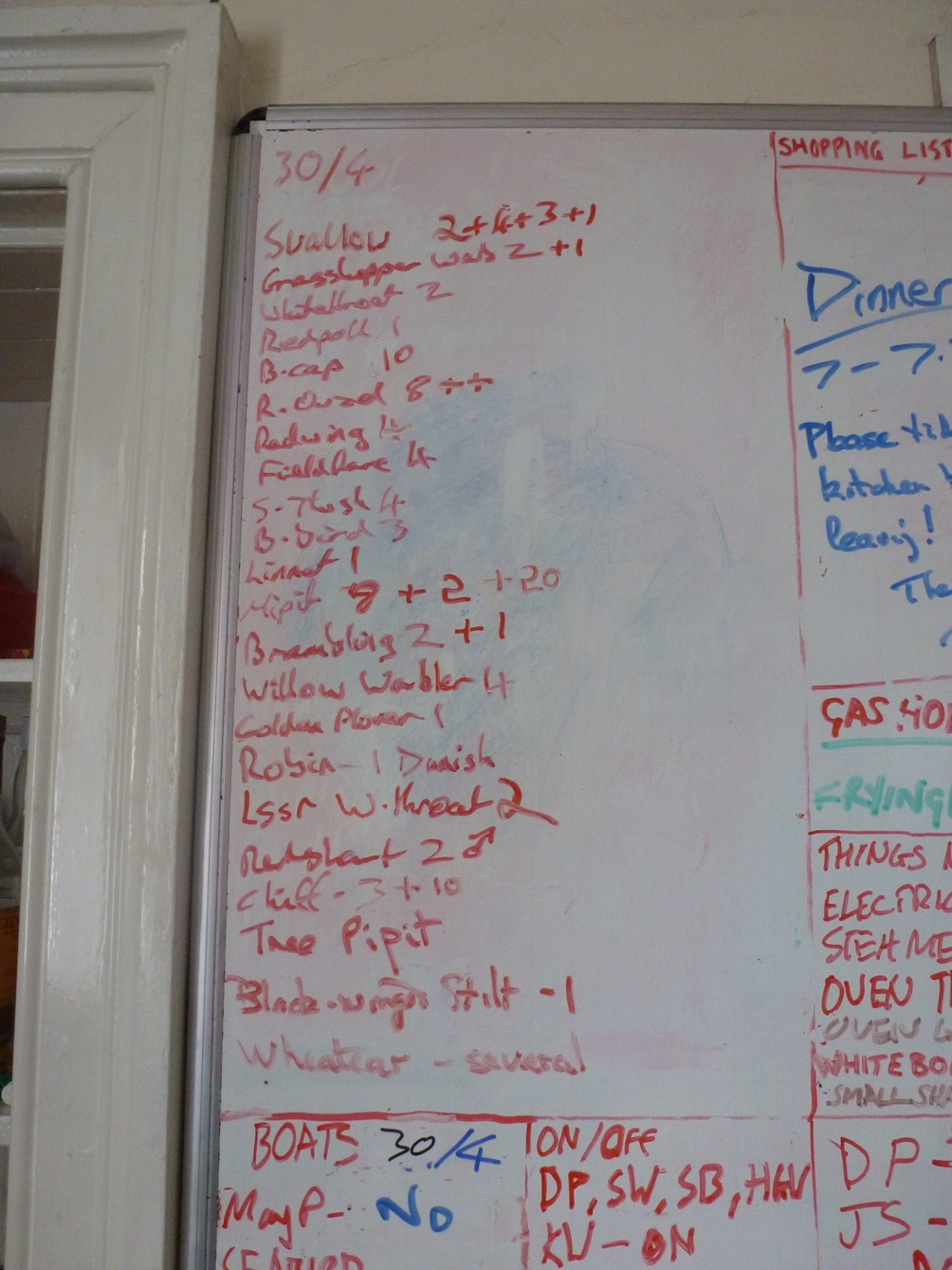
Mikes field notes!
There was also a Nightingale present on the island. This is another very rare bird for Scotland. David and I managed to photograph it to help identify from it's very close relative, Thrush Nightingale.
Nightingale
The board on Monday.
Labels:
autumn puffin lighthouse holiday,
BBC,
birding,
birds,
Edinburgh,
fife,
long gorgeous legs,
owls,
princess,
puffins,
Scotland,
Scotland scenery fife lothian,
seals,
shag beer Isle of May NNR,
vagrant,
waders
Subscribe to:
Posts (Atom)