Showing posts with label owls. Show all posts

Wednesday, 2 May 2012

Black-winged Stilt - First record for the Isle of May


On the 30th April I'd just settled down for a late lunch when Mike Harris dashed in shouting he'd seen a Black-winged Stilt at Horse Hole. I dropped my Sandwich and ran to the other end of the island. Unfortunately the bird had gone. I proceeded to search all other water bodies on the island with Mark.

The last place to search was the South Plateau where there are two small pools. As we climbed the slope Mark spotted the bird at the back of the pool. We were delighted. It was a very unlikely vagrant first for the island.

The bird is an elegant wader. Black above and white below with a black cap and a needle thin mid length. It's most defining feature is the long pink legs.

Black-winged Stilts are resident in the Mediterranean with a few breeders in creeping up to northern France. They are a rare visitor to the south coast of Britain with only eight previous records for Scotland. The last time this species was seen  was in the Outer Hebrides in July 1990.

We released the news. The bird was twitched by just a couple of mainland birders but hopefully more visitors will be able to enjoy it if it stays.


 Mikes field notes!

There was also a Nightingale present on the island. This is another very rare bird for Scotland. David and I managed to photograph it to help identify from it's very close relative, Thrush Nightingale.


Nightingale
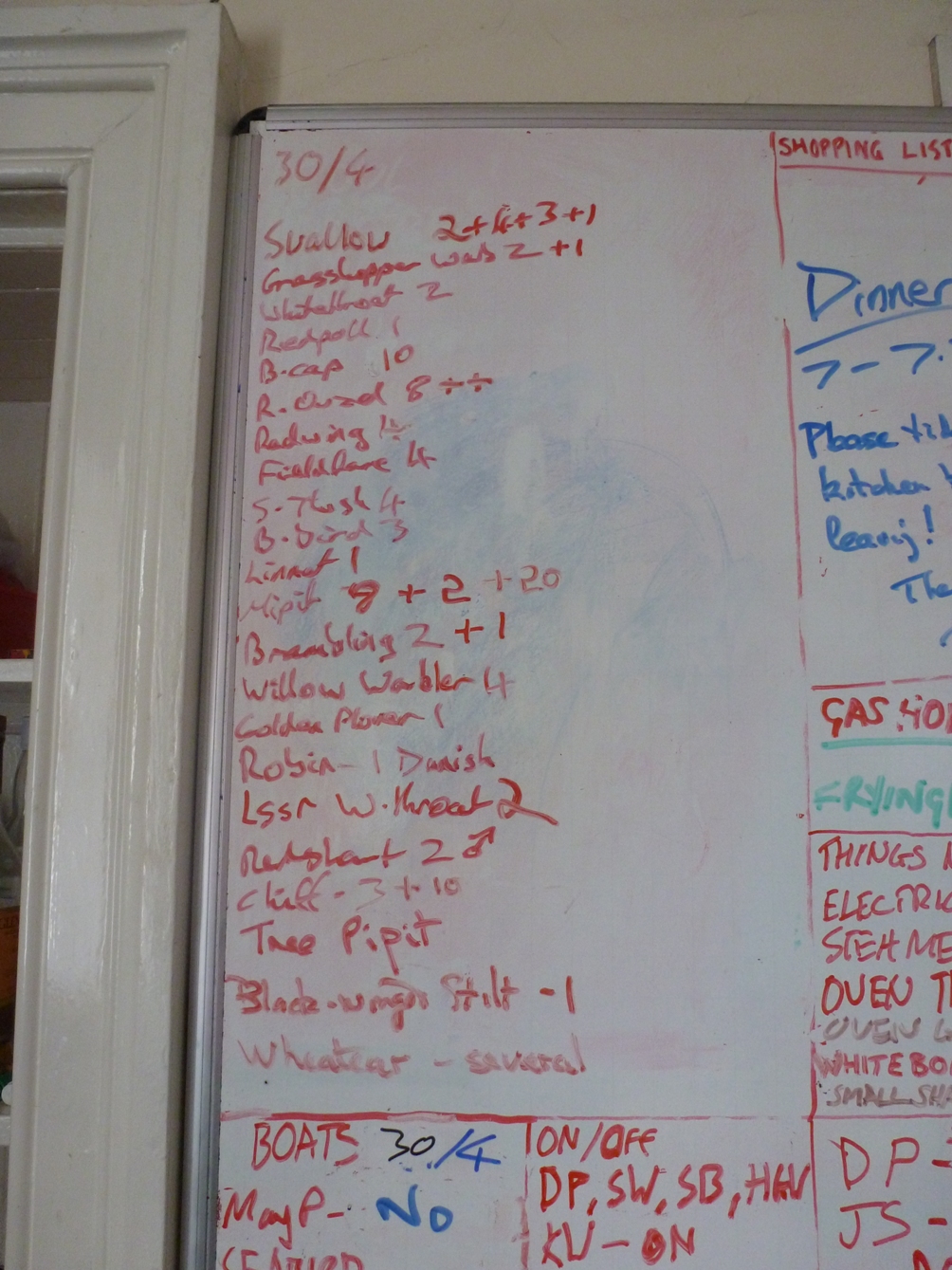

The board on Monday.

Sunday, 29 April 2012

Long-eared Owl

Long-eared Owl


I'd had my Sunday breakfast and decided to go for a stroll. I stopped in and watched the Eiders for a while as the males were displaying to the female. I began to walk up Palpitation Brae up to the Mainlight pausing briefly for a look at a Chiffchaff and a male Ring Ouzel. As I got to the top I could hear a commotion in the Arnott trap. The Pied Wagtails and Robins were all alarm calling. I peeked over the wall to see a Long-eared Owl looking back at me. I dropped back down behind the wall and got the camera out. I rattled off a few shots but the attention of the Pied Wagtail was too much and the nervous bird flew into the cover in the trap. 

I walked back down to the Lighthouse Keepers cottages to find Mark to see if he wanted to trap it. He had actually seen the bird flying onto the island with an entourage of gulls. Though he had not even had his breakfast we set off to see if we could trap it only briefly pausing to stop and look at a Tree Pipit along the way.


Mark expertly and safely trapped the bird and took it to the ringing hut. The bird was ringed, weighed and measured.


Fluke Street and Lowlight occupants all were present with cameras.


The owl was released along Holymans Road away from the gulls. From here it would see the Lowlight bushes where it would be able to roost safely. 

Long-eared Owl is principally an Autumn migrant on the Isle of May. This season seen three already and trapped two of them. Both birds have been adult females. These may well be migrating north to breed in a woodland somewhere in Scotland. They are nocturnal and hard to find so it's always a pleasure to get a view of this breath taking species. 


Saturday, 28 April 2012

A week of birds!


The wind has mostly been coming from the north east this week . This is not great for a couple of reasons. The boats have been unable to land so we've seen few visitors this week and birds which are heading to the continent are having their migration hindered. However there have been lots of birds around the island for us to see and for Mark to trap.


This will not be the last picture of a Long-eared Owl you will see this season if we see more on the island


The lovely black black chin of a male Redstart. There have been three of these cracking birds present on the this weekend. They normally breed in birch trees on the mainland of which there are none on the Isle of May.


The injury to Marks hand was not done by the Redstart!


Here is the Redstart hopping around looking for food in the bare vegetation near the tractor shed.


This is a 'Continental' Robin. It is bigger, greyer with a more orange breast then the birds that breed in back gardens in the UK.

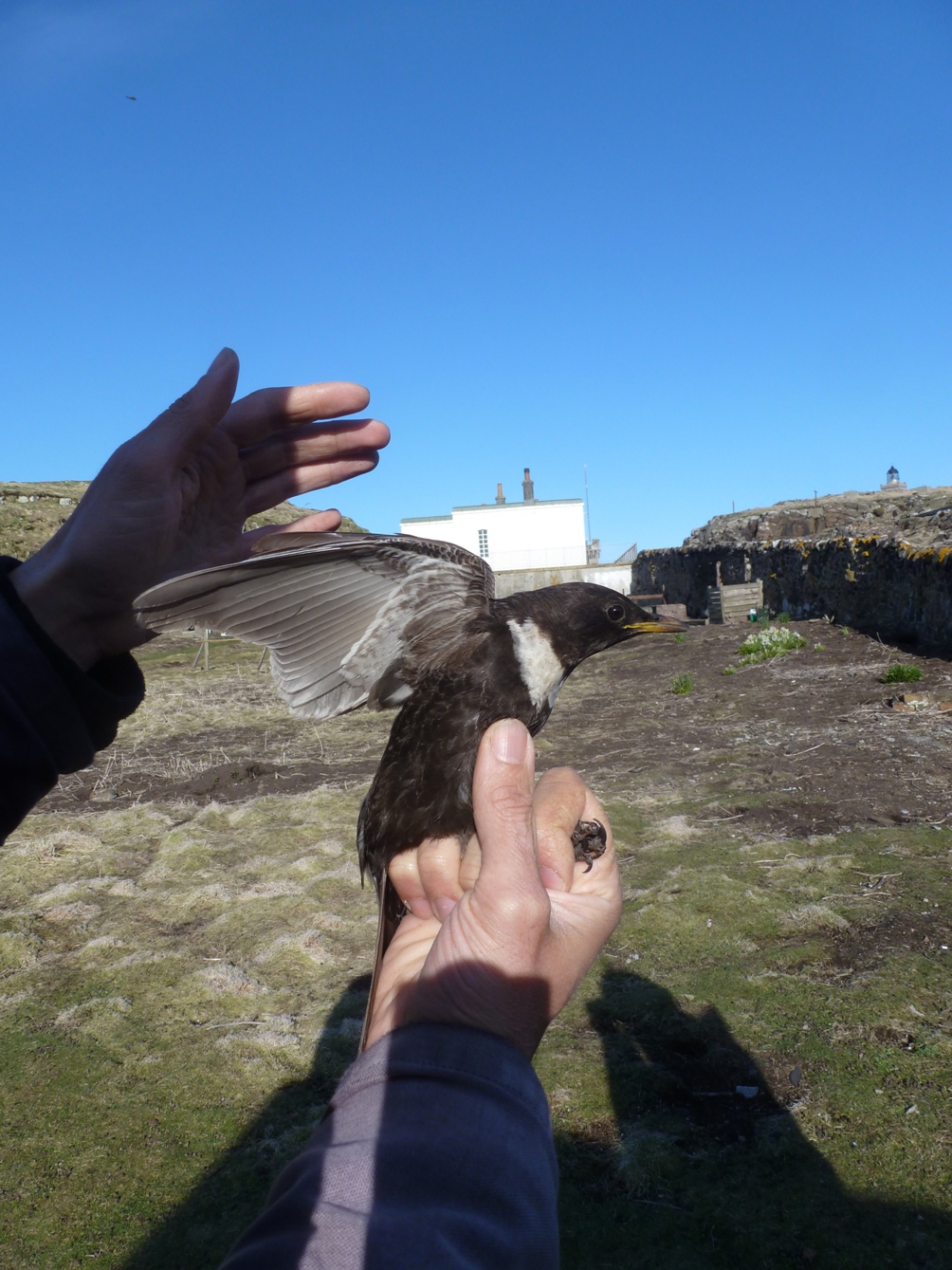
This Ring Ouzel breeds in the mountains. Is it trying to make it's way to Scandinavia?


A close look at this  different Ring Ouzel shows it is carrying a tick.


This is the first Fieldfare I've seen in the hand. What a fantastic bird to see up close!


Here is a Mark doing an impression of James Herriot calving. He's really extracting birds from the catching box.


We've been catching more then just birds in the trap. The girls were more delighted then the rabbits.