Showing posts with label birding. Show all posts

Thursday, 12 July 2012

Compost Gull and Seawatching

It's often a subject around the dinner table between the summer residents of the Isle of May on whether it is always the same Lesser Black-backed Gull that visits the compost heap that is just outside the Lighthouse Keepers cottage.

The compost heap mainly consists of a few rotting citrus fruits and spent ground coffee, but the odd bit of left over pasta or dead bird keeps the gulls returning daily.


About a week ago Mark successfully trapped a gull in the heap and Carrie got to ring her first Lesser which was seen returning to the garden within a couple of days.


It became quite obvious there was more then one gull using the compost heap as unringed birds were noted daily, so while I was having a post dinner seawatch from the veranda I decided to try and catch an unringed bird that was using heap.


I hid in the mothtrap shed and waited for the signal from Mark and Lowlighters, Steve and Ian who had come out to join us looking out to sea. After about 15 minutes the bird dropped into the wooden frame so I decided to go for it.


The bird panicked on my appearance and got stuck, it's path blocked by my considerable bulk flying over the side. I landed ankle deep in some pretty rotten horrid filth of the heap, but the bird was secured.


 We took the bird to the ringing hut where it was ringed by Ian and released.


Close up the bird was quite stunning. Close up you can see the details of the eye and the wings. The bird was not too pleased about being caught and really gave as good as it got.This bird is marked with a green colouring with the letter M on it. We shall keep an eye on the compost heap to see which birds return the compost heap.

The fun did not stop there either. While we were watching the sea, we noted Arctic Skua, Manx Shearwaters, a probable island record count of Common Scoter, Harbour Porpoise and a Minke Whale.

Minke Whales are noted off the island regularly throughout the season with an increase of sightings from mid July onwards. Tonight's sighting was quite special as the Minke was jumping right out of the water! It leeped out near a fishing boat. Even though the animal was over a mile away you could see the tidal wave splash with the naked eye! It almost made me jump out of my skin as it came right up in my field of view in my telescope.

We don't watch the TV out here but with that kind of nightly entertainment who needs to?

I'd like to thank Ian and Mark for contributing photographs for this blog entry.

Sunday, 8 July 2012

Wood Sandpiper

A little late night bonus blog here.... 

When a Wood Sandpiper flew into the pools on the South Plateau at Dusk, an island twitch was on. 

I managed to locate the Lowlighters and then run up Palpitation Bray to locate Mark who I'd seen at at Sheep Well from about 20 minutes before from the other side of the Loch. It was an Isle of May 'tick' for him.

We all managed to see the bird well. Hopefully the bird will be still here in the morning so we don't have to look at it in the half light.


Wood Sandpipers are a scarce passage migrant in the UK. They are a reasonably common breeding wader in Boreal forests in Scandinavia. This is only the 24th for the Isle of May though the last record was only in 2010.It is also the earliest autumn record for the island. The bird that was seen today was a moulting adult.

Saturday, 7 July 2012

Unusual Guillemot


 This unusual Guillemot has been present on the Isle of May for the last three seasons. I've looked for it a few times but had not seen it until the researchers said it was present yesterday. Calum and I went up to the cliffs and despite the poor conditions I managed to capture a few images of the bird.


 The bird has an orange bill and orange feet. It lacks the black pigment in it's bare parts. These birds are not unheard of in the wild and aberrant birds of many species are known. It is a very nice bird to see indeed.


The Guillemot shares a ledge with a Razorbill


A close up of the head

 It has orange feet with black ends to the webs.

The bird has been affectionately named 'Penguillemot' by the researchers because of it's unusual appearance.

Thursday, 5 July 2012

Shag GZJZ - Another rescue from discarded waste...

Another Lucky Shag


Visitors had been reporting a juvenile Shag with some rubbish around it's neck at The Alterstanes. It was looking bad for the bird. Now it was away from the nest it would be almost impossible to catch.

The bird had been ringed on the 2nd June near The Alterstanes at Horse Hole. It wore a ring with the letters GZJZ.


The bird  was expertly caught by Mark by climbing stealth like, as it sat on the rocks. He carried it up and we cut the detritus off it. It was likely that this rubbish was in the birds nest and this is where it picked it up.


The bird was released after it's ordeal. The bird was still in relatively good condition. It had been managing to catch fish even with this rubbish round it's neck.


This is a perfect example of how throwing litter into the sea can have a direct impact on the birds of the Isle of May.

This bird and the now famous 'Beer Shag' that we wrote about last year were lucky ones. How much of our other sea life is not so lucky?


Monday, 2 July 2012

Chicks Special...

We are over half way through the breeding season but there is still lots to see around the Isle of May NNR. Lot's of balls of fluff are still to be seen all over the island.


Eider Ducklings are doing well on the loch


An Arctic Tern chick wedges itself between rocks in an attempt to camoflage


 This little Arctic Tern chick has only hatched recently


This Tern chick likes to run around at the feet of May Princess passengers while they disembark to boat


Pied Wagtails are still producing young. They are one of the two regular breeding songbirds on the island


The Lesser Black-backed Gulls looking over their two chicks


A Puffling is stuck in the vegetation. This bird was released at dusk


Plump Kittiewake chicks near the South Horn 


A Guilliemot chick sits in the shade of it's parent


                          One of the dozen or so Oystercatcher chicks that are around the Island


I managed to get a few close up shots of the Island Longtails. Not a chick but still quite cute!

Sunday, 1 July 2012

Tern Update

Tern Update


The Terns continue to terrorise the visitors near the landing on the Isle of May. Lucie and Paula are still closely monitoring the birds. There are still a fair few chicks hidden in the long vegetation. These birds have survived the Gulls and the terrible weather so fingers crossed things will improve.


I counted at least 13 Common Tern chicks at the beacon.


See how they form an orderly que to go into the little shelters. The Common Tern in the foreground is still on two eggs.


The canes do appear to make it awkward for Gulls to land.

The jetty Oystercatchers can roost easy knowing the noisy Terns will alert them to any danger.

Friday, 8 June 2012

The All Island Count

Anyone who visits the island who stands before David and I will hear us say that our job is to meet the boats and count all the seabirds you can see. David and I had a team of volunteers to help us count all the seagulls on the island but when it comes to the All Island Count, 'I'm on my own*'!

I have to count all the cliff dwelling birds. It is quite a daunting task counting thousands of seabirds, Many of which are parts of large colonies. In some ares I can easily see 5000 birds on one cliff face.

I'm often asked how I count so many birds. Well, it's simple! I literally count every individual bird from a safe vantage point. I use a clicker and cover every shelf, ledge, crag and gully of every cliff face.I scan the cliffs with my binoculars. I also take lots of notes and drawings so I don't count the same bird more then once. The island is split up into 16 sections and the totals are added up when the count is complete. It's of the only chance I get to go to secret places around the reserve, creeping along gullies or leaping around the rocks at low tide.


 Kittiwakes, Razorbills and Guillemot are the three most numerous species


I get to creep around little secret Gullies around the island. A Razorbill nearly took my head off flying down this one!


The south horn colony is counted from The Maidens


Counting the high cliffs is quite exciting especially in the fog


A lot of Razorbills were just hatching as I was counting.


Playing on cliffs is dangerous kids. Rope up safe!


That's me looking down 40 metres to the sea!


 How many?


David has a clifftop snooze while waiting to come back from the Maidens

Now come thes report writing and adding up. I'll be reporting back on that soon.

*David kindly helped me with my rope work and The Centre of Ecology and Hydrology helped counting the more sensitive areas where there are the highest density of shags.

Monday, 21 May 2012

Bluethroat

The winds were from the north east and the rain fell on Thursday and Friday. There was no field work. By the evening  the rain had stopped. Mark came in to say he'd seen a Bluethroat on the south of the Island.

Bluethroats are small birds that are not so distantly related to Robins. They breed in Scandinavia. They do not breed in Britain but they are a scarce spring migrant along the east coast. The Isle of May sees this species almost annually. The males have a lovely 'cornflower blue' throat with a red spot in the middle.

I missed the bird that Mark saw but on Saturday morning I was going over to pick the luggage up for the Bird Observatory. I saw a plump bird with a short tail and a strong facial pattern jump out of a ditch. A Bluethroat! The bird ran around feeding quickly and was very difficult to photograph. It flew away towards the main light and disappeared. I proceeded to go down to the Lowlightlight and when I got to Horse Hole and the same happened. Another female Bluethroat! And I had not even got off the quadbike!


The Bluethroats skulks behind a rock


A different bird was ringed in the afternoon


Out in the open enjoying the early evening sunshine


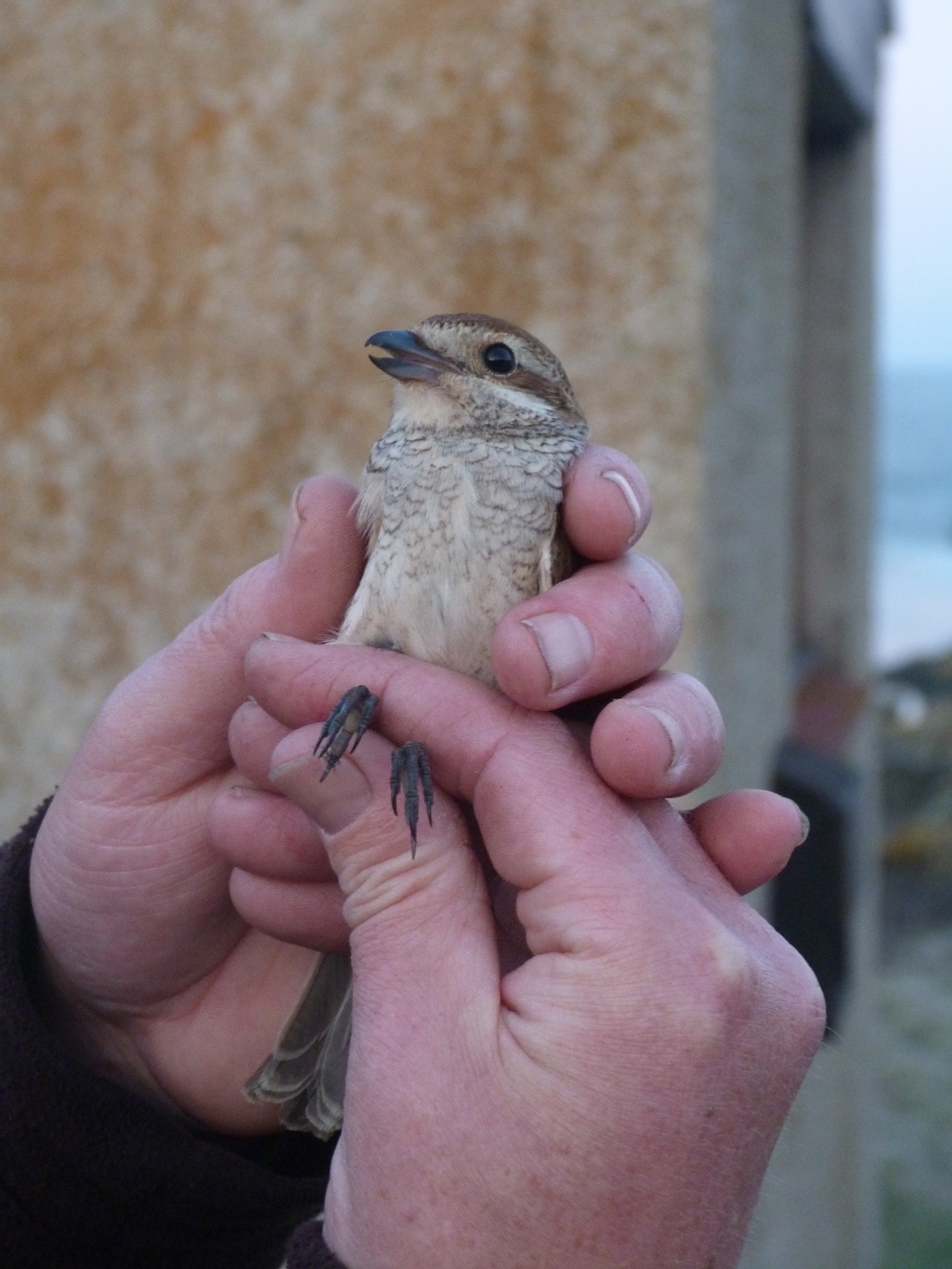
Later in the evening I was escorting our new volunteer Lucie to the Lighthouse . On our way back I found a female Red-backed Shrike. Another scarce migrant to the east coast. We enjoyed watching the bird catching flies and flying from stalk to stalk. Then the ringers caught it.


A female Yellow Wagtail dropped in to add more colour to the proceedings.

There were a lot of common migrants to see. Those lucky enough to be out on the boat on Sunday were treated to a selection of these birds including one regular who was delighted by not only seeing but photographing his first Bluethroat.


Wednesday, 2 May 2012

Black-winged Stilt - First record for the Isle of May


On the 30th April I'd just settled down for a late lunch when Mike Harris dashed in shouting he'd seen a Black-winged Stilt at Horse Hole. I dropped my Sandwich and ran to the other end of the island. Unfortunately the bird had gone. I proceeded to search all other water bodies on the island with Mark.

The last place to search was the South Plateau where there are two small pools. As we climbed the slope Mark spotted the bird at the back of the pool. We were delighted. It was a very unlikely vagrant first for the island.

The bird is an elegant wader. Black above and white below with a black cap and a needle thin mid length. It's most defining feature is the long pink legs.

Black-winged Stilts are resident in the Mediterranean with a few breeders in creeping up to northern France. They are a rare visitor to the south coast of Britain with only eight previous records for Scotland. The last time this species was seen  was in the Outer Hebrides in July 1990.

We released the news. The bird was twitched by just a couple of mainland birders but hopefully more visitors will be able to enjoy it if it stays.


 Mikes field notes!

There was also a Nightingale present on the island. This is another very rare bird for Scotland. David and I managed to photograph it to help identify from it's very close relative, Thrush Nightingale.


Nightingale


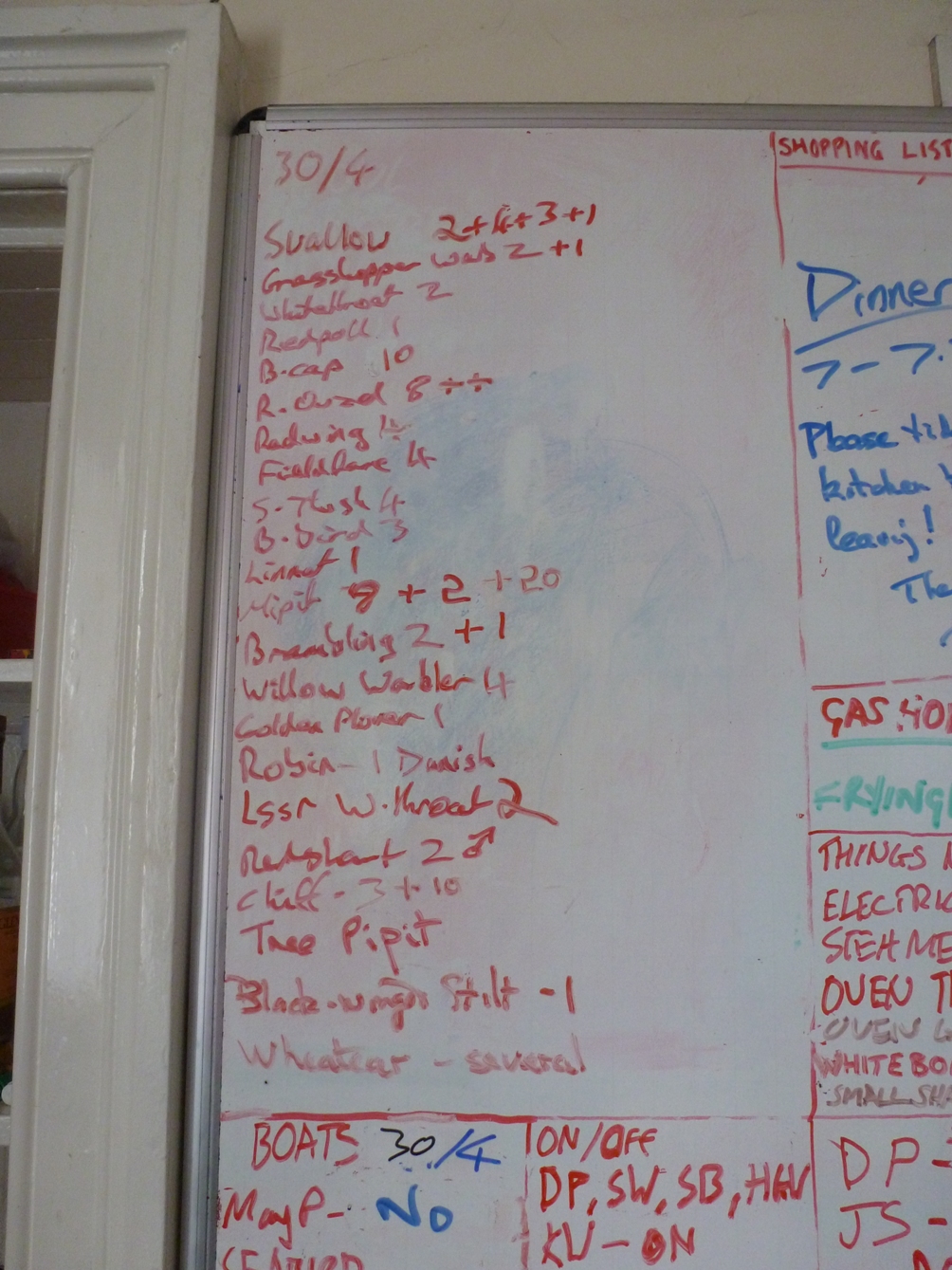
The board on Monday.